English Opening (1.c4): Moves, Plans and Main Lines
The English Opening starts with 1.c4. White takes control of the d5 square from the side, keeps the centre pawns at home for a while, and often puts a bishop on g2. This guide explains the ideas, the main replies for Black with their ECO codes, and the 29 English lines you can train on Rama Chess.

What is the English Opening?
The English Opening is 1.c4. White pushes the c-pawn two squares and looks at the d5 square from the side. It is a flank opening: White does not put a pawn in the centre on move one, but the centre is still the target.
The name comes from Howard Staunton, the leading English player of the 19th century. He played 1.c4 in his 1843 match against Saint-Amant. It only became popular much later, in the 20th century. Its ECO codes are A10 to A39.
The English is flexible. White can later play d4 and reach a Queen's Gambit or a Catalan, or keep the d-pawn on d3 and build a slow set-up with g3, Bg2, Nc3 and e4. Because of this, many players use it to avoid the main lines their opponents know best.
The main ideas for both sides
White's plans
- The g2 bishop. After g3 and Bg2, the bishop presses on the long diagonal against d5 and b7.
- Queenside expansion. Moves like Rb1, a3 and b4 gain space on the queenside, where the c4 pawn already helps.
- Control of d5. The c4 pawn, the Nc3 knight and the g2 bishop all watch d5. A white knight on d5 is often very strong.
- The d4 break. At the right moment White plays d4 to open the centre.
Black's plans
- Take the centre. Black often answers with ...e5 and builds a real centre, because White has not played e4 or d4 yet.
- The ...d5 break. If Black can play ...d5 safely, the c4 pawn is challenged and Black gets free play.
- Copy and wait. In the Symmetrical English Black mirrors White with ...c5, ...g6 and ...Bg7 and waits for White to commit.
The Reversed Sicilian: 1.c4 e5
After 1.c4 e5 the position looks like a Sicilian Defense with the colours reversed. White plays the "Black" side, but with an extra move. That extra tempo is why White can use quiet plans and still keep an edge.
The most common set-up is the Four Knights: 1.c4 e5 2.Nc3 Nf6 3.Nf3 Nc6. Now 4.g3 (A29) is the main move. If Black plays 4...d5 5.cxd5 Nxd5 6.Bg2 Nb6, we get a real reversed Open Sicilian. White castles and plays a3 and b4 to attack on the queenside.
Black can also play 4...Bb4, pinning the c3 knight and later taking on c3 to double White's pawns.
| Variation | ECO | Moves | Idea |
|---|---|---|---|
| Reversed Sicilian (King's English) | A20-A29 | 1.c4 e5 | a Sicilian with colours reversed and an extra move for White |
| Four Knights, 4.g3 | A29 | 1.c4 e5 2.Nc3 Nf6 3.Nf3 Nc6 4.g3 | the bishop goes to g2 |
| Symmetrical English | A30-A39 | 1.c4 c5 | Black copies White and fights for d4 |
| Anglo-Indian | A15-A19 | 1.c4 Nf6 | Black keeps options for ...e6, ...g6 or ...e5 |
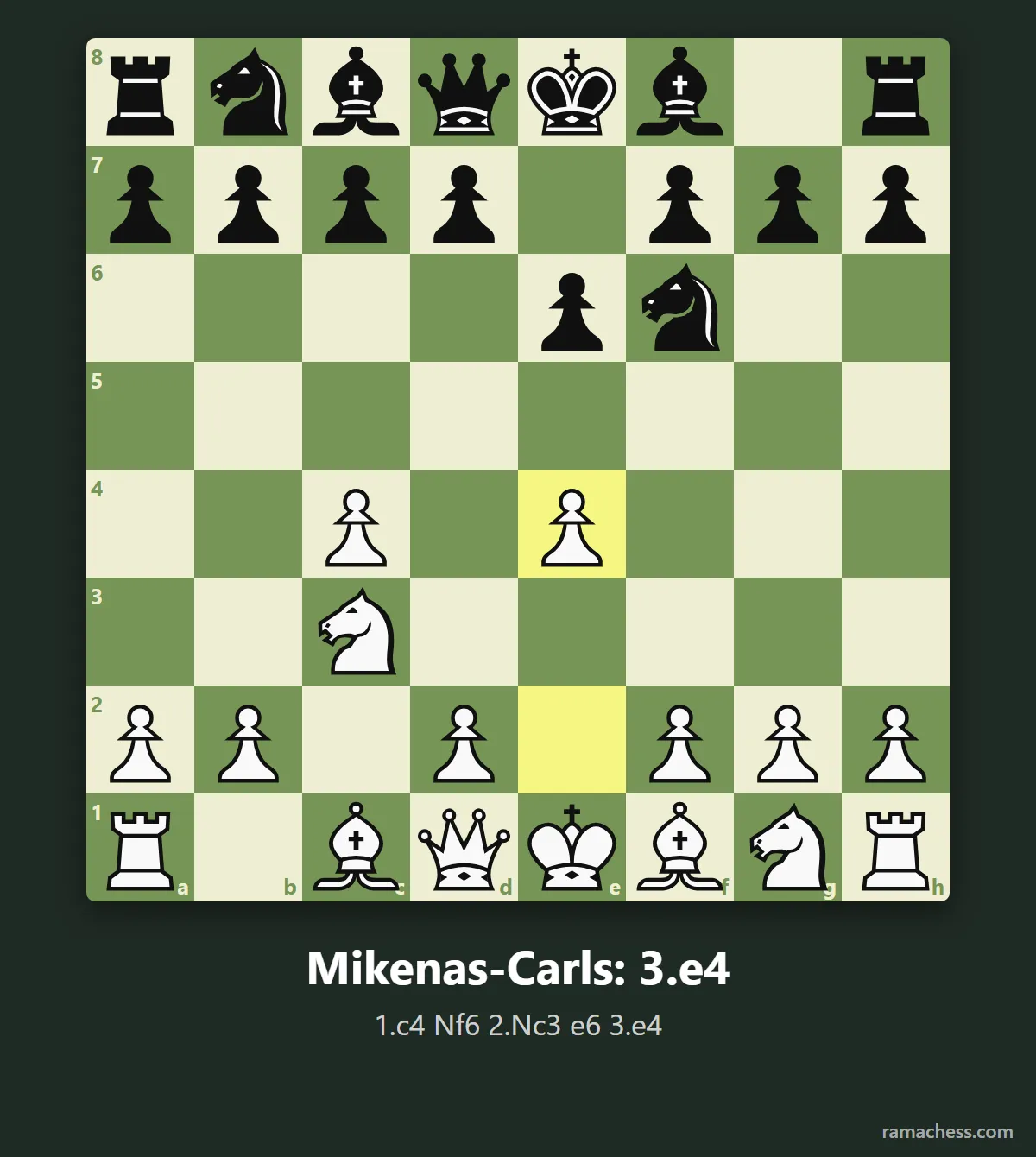
| Mikenas-Carls | A18 | 1.c4 Nf6 2.Nc3 e6 3.e4 | White takes the whole centre |
| Botvinnik System | A30-A39 | 1.c4 c5 2.Nc3 Nc6 3.g3 g6 4.Bg2 Bg7 5.e4 | pawns on c4 and e4, a grip on d5 |

Symmetrical English and the Anglo-Indian
With 1.c4 c5 Black copies White. This is the Symmetrical English (A30-A39). Both sides often fianchetto, and the game is slow and strategic. White's Botvinnik System, with pawns on c4 and e4 and the bishop on g2, is one famous plan. It grips d5 and prepares a kingside push with f4.
With 1.c4 Nf6 Black plays the Anglo-Indian. Black can still choose ...e6 (towards Queen's Gambit or Nimzo-Indian type play), ...g6 (King's Indian or Grunfeld type) or ...e5. After 1.c4 Nf6 2.Nc3 e6 White has the sharp 3.e4, the Mikenas-Carls Variation (A18). Black's main reply is 3...d5 4.e5, when the play becomes very sharp.
Typical tactics to know
The English is a strategic opening, so there are fewer quick traps than in the Open Sicilian. These are the patterns that win most games:
- The long diagonal. The g2 bishop looks all the way to b7 and a8. If Black moves a knight from d5 or c6 without care, a rook on a8 or a pawn on b7 can drop.
- Nd5 jumps. A knight on d5 hits c7 and f6 and can fork pieces on those squares.
- The b4 push. In the Reversed Sicilian, b4-b5 chases the c6 knight away from the defence of e5.
- Doubled c-pawns. If Black plays ...Bb4 and ...Bxc3, White gets doubled pawns but the bishop pair. Know which side you prefer before you enter these lines.
Who plays the English Opening?
The English has been used in world championship matches by Mikhail Botvinnik, Tigran Petrosian, Anatoly Karpov, Garry Kasparov, Magnus Carlsen and Ding Liren. Bobby Fischer, famous as a 1.e4 player, also used it in his 1972 match against Boris Spassky. Ding Liren won key games with 1.c4 in his world championship matches of 2023 and 2024.
Engines like it too. You can watch it in our engine games in the English Opening.
Practice the English Opening in the Rama Chess trainer
Reading a guide is the first step. To make the moves stick, practise them. Our opening trainer has 29 English Opening lines. Each one is checked with Stockfish. You watch the moves with arrows, replay them from memory, then take a test. The full set of lines is part of Rama Chess Premium.
Most of our English lines are for White. Begin with the Four Knights with 4.g3 (A29), the line you will meet most often after 1...e5.
See all our chess opening guides.
English Opening FAQ
What is the English Opening in chess?
The English Opening is the first move 1.c4. White controls d5 from the side and keeps a flexible position. It has the ECO codes A10 to A39.
Why is it called the English Opening?
It is named after Howard Staunton, the top English player of the 19th century, who played 1.c4 in his 1843 match against Saint-Amant.
Is the English Opening good for beginners?
It is sound and safe, but it is slow and strategic. Beginners can play it, but they need to understand plans, not only moves. 1.e4 or 1.d4 openings teach the basics faster.
What is the best reply to the English Opening?
The most common replies are 1.c4 e5 (the Reversed Sicilian), 1.c4 Nf6 and 1.c4 c5. All three are fully sound.
What is the Reversed Sicilian?
It is the English after 1.c4 e5. The pawn structure is like a Sicilian Defense with the colours swapped, so White plays a Sicilian with an extra move.
Which world champions played the English?
Botvinnik, Petrosian, Karpov, Kasparov, Carlsen and Ding Liren all used it in world championship matches, and Fischer used it against Spassky in 1972.
Watch on YouTube
Prefer video? Our channels show real games move by move, with clear explanations.
Ready to practise?
You know the ideas. Now train the moves until you play them without thinking.