Catalan Opening: Moves, Plans, Main Lines and Ideas
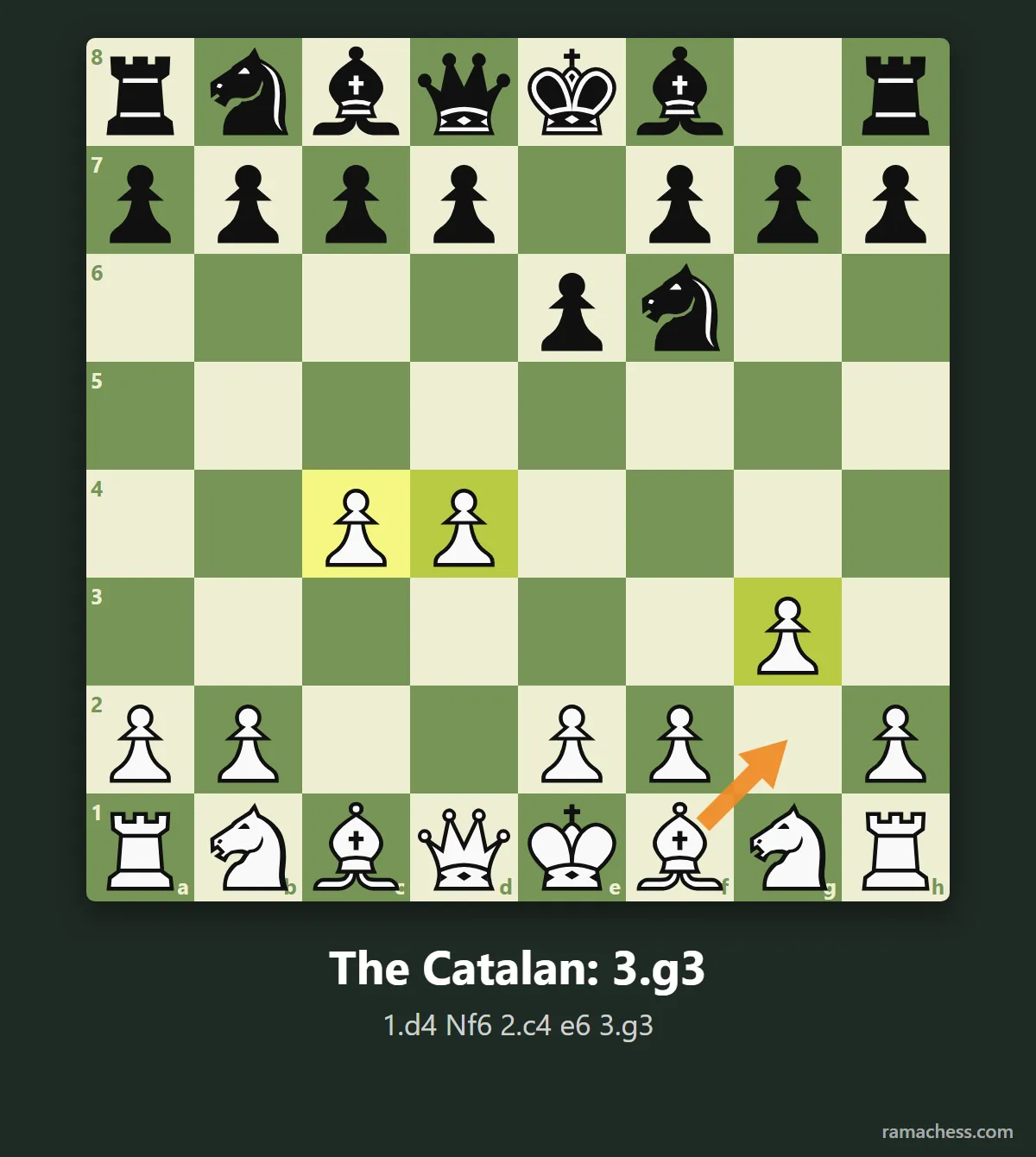
The Catalan is a favourite of world champions. White combines the Queen's Gambit with a kingside fianchetto: 1.d4 Nf6 2.c4 e6 3.g3. The bishop on g2 puts long-term pressure on Black's queenside. This guide shows the moves, the plans, the Open and Closed lines with ECO codes, typical tactics and 29 lines you can train on Rama Chess.
The Catalan Opening starts 1.d4 Nf6 2.c4 e6 3.g3, usually followed by 3...d5 4.Bg2. White puts pawns on d4 and c4 (like the Queen's Gambit) and the bishop on g2, aiming down the long diagonal at b7 and a8. Black chooses between the Open Catalan (4...dxc4, taking the pawn) and the Closed Catalan (4...Be7, keeping it). It is a safe, strategic opening for White, played in many World Championship matches.

- What is the Catalan Opening?
- The main ideas for both sides
- Main variations of the Catalan
- Catalan vs Queen's Gambit and other 1.d4 openings
- How to play the Catalan as White: a simple plan
- How to play against the Catalan as Black
- Typical tactics in the Catalan
- History: why is it called the Catalan?
- Who plays the Catalan?
- Practice it in the trainer
- Related pages
- FAQ
What is the Catalan Opening?
The Catalan starts with 1.d4 Nf6 2.c4 e6 3.g3, usually followed by 3...d5 4.Bg2. White plays the Queen's Gambit pawns on d4 and c4, and adds a fianchetto: the bishop goes to g2, where it looks down the long diagonal at d5, c6, b7 and a8.
The idea is long-term pressure. White often does not mind losing the c4 pawn for a while, because the g2 bishop and quick development make it hard for Black to keep it.
White can also reach the Catalan with a different move order, for example 1.d4 Nf6 2.Nf3 e6 3.c4 d5 4.g3 or 1.Nf3 Nf6 2.c4 e6 3.g3 d5 4.d4. The plans are the same.
The main ideas for both sides
White's plans
- The g2 bishop. Everything works around the long diagonal. Black's queenside, especially b7 and a8, feels the pressure.
- Win c4 back slowly. With Qa4+, Qc2, Ne5 or a4, White regains the pawn and often keeps a lasting edge.
- The e4 push. In the Closed Catalan White aims for e4 to take more space.
Black's plans
- Take on c4 (Open Catalan). Black grabs the pawn and tries to use the time to develop or to hold it with ...a6 and ...b5.
- Stay solid (Closed Catalan). Keep the pawn on d5, play ...Be7, ...O-O, ...Nbd7 and ...c6.
- Free the c8 bishop. As in the Queen's Gambit Declined, this is Black's long-term task, often with ...b6 and ...Bb7 or ...c5.
Main variations of the Catalan
Every move order below is checked move by move.
| Variation | ECO | Moves | Idea |
|---|---|---|---|
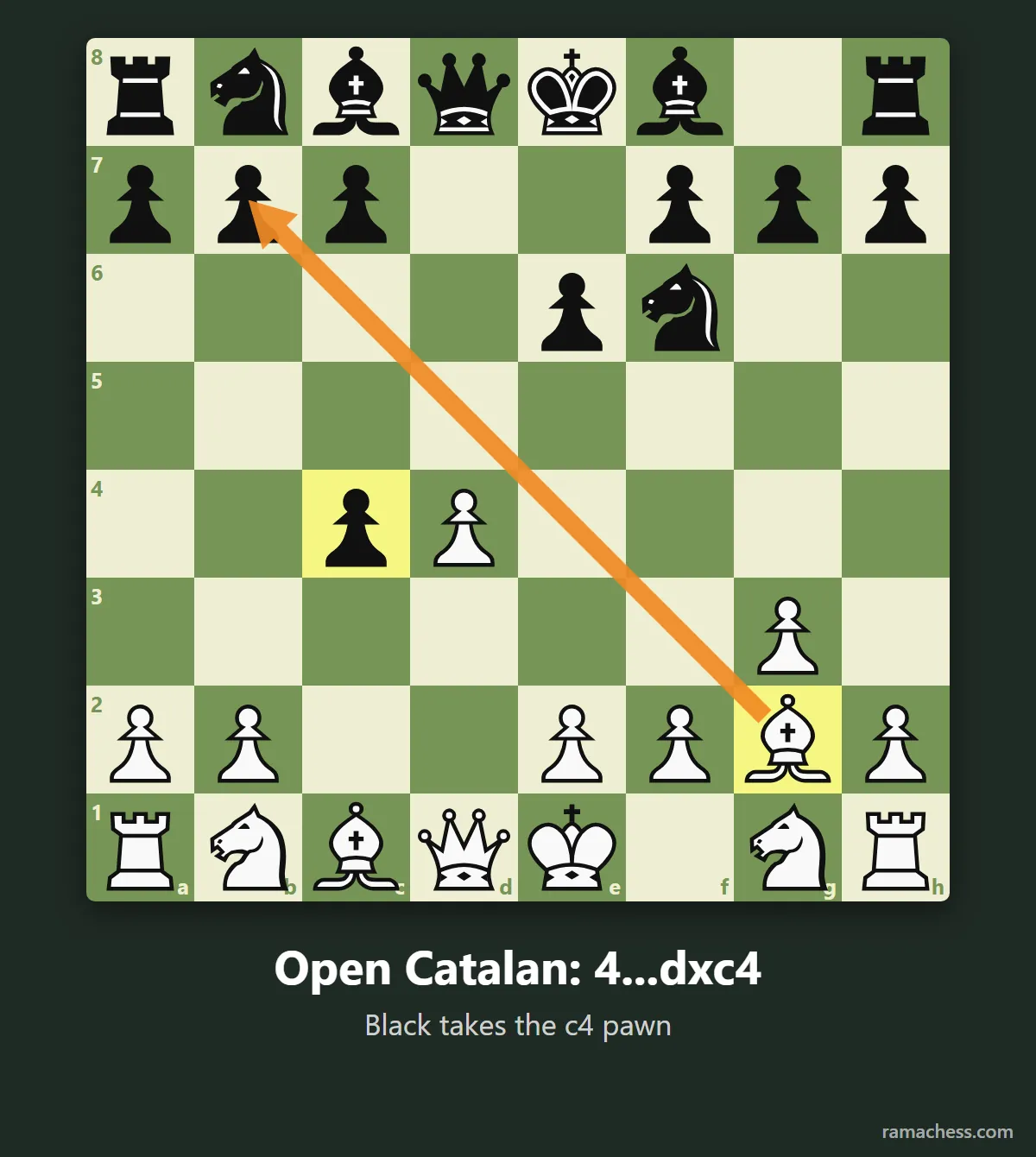
| Open Catalan | E02-E05 | 1.d4 Nf6 2.c4 e6 3.g3 d5 4.Bg2 dxc4 | Black takes c4 and must decide how long to hold it |
| Open Catalan 5.Nf3 | E04 | 1.d4 Nf6 2.c4 e6 3.g3 d5 4.Bg2 dxc4 5.Nf3 | the normal way; White does not hurry to win c4 back |
| Open Catalan, Classical | E05 | 1.d4 Nf6 2.c4 e6 3.g3 d5 4.Bg2 dxc4 5.Nf3 Be7 | calm development before ...a6 and ...b5 |
| 5.Qa4+ line | E02-E03 | 1.d4 Nf6 2.c4 e6 3.g3 d5 4.Bg2 dxc4 5.Qa4+ | win the pawn back at once |
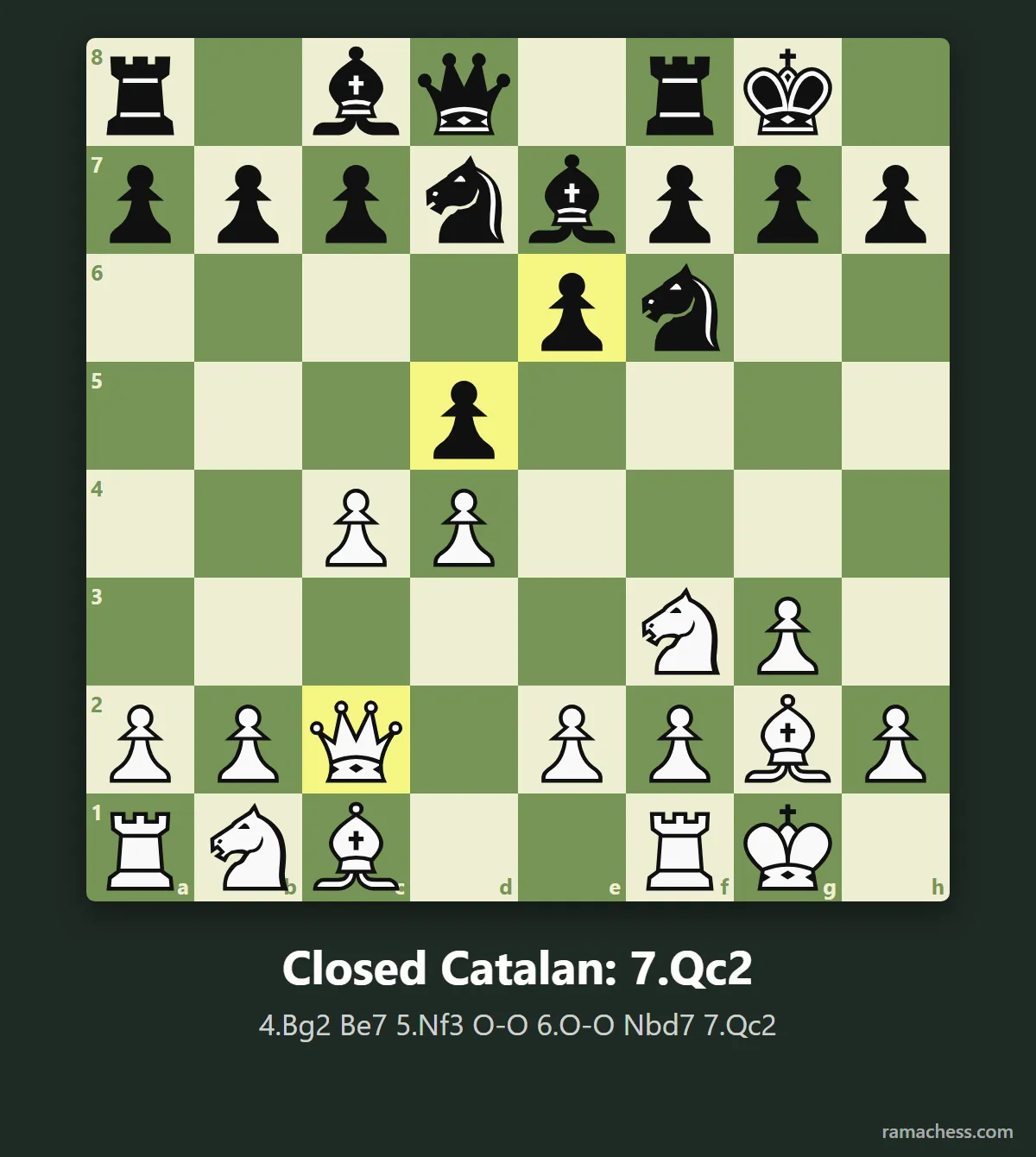
| Closed Catalan | E06-E09 | 1.d4 Nf6 2.c4 e6 3.g3 d5 4.Bg2 Be7 | Black keeps d5; slow, strategic play |
| Closed, 7.Qc2 | E08 | 1.d4 Nf6 2.c4 e6 3.g3 d5 4.Bg2 Be7 5.Nf3 O-O 6.O-O Nbd7 7.Qc2 | White prepares e4 |
| Bogo-Indian style | E01 | 1.d4 Nf6 2.c4 e6 3.g3 d5 4.Bg2 Bb4+ | the check to swap the dark bishop |
The Open Catalan (3...d5 4.Bg2 dxc4) is the most direct test. After 5.Nf3 Black chooses between giving the pawn back calmly with ...Be7 or ...c5, and trying to hold it with ...a6 and ...b5. A main line goes 5...a6 6.O-O Nc6 7.e3 Bd7 8.Qe2 b5.
The Closed Catalan (3...d5 4.Bg2 Be7) is quieter. Black does not take on c4 and builds a QGD-style position. White keeps a small but stable space advantage.
What the engine says. We checked the main choices with Stockfish 18 (depth 24, 15 October 2026). After 4.Bg2 every main reply keeps the game close to equal: 4...dxc4 5.Nf3 about +0.3, 4...Be7 about +0.3 and 4...Bb4+ about +0.3 for White. That is the normal small first-move edge, the same size as after 1.e4 or 1.d4 alone. The Catalan does not win by force; it gives White a safe position with long-lasting pressure.
Catalan vs Queen's Gambit and other 1.d4 openings
The Catalan is close to the Queen's Gambit, but the bishop on g2 changes the character of the game.
| Opening | Typical moves | Where the f1 bishop goes | Style |
|---|---|---|---|
| Catalan | 1.d4 Nf6 2.c4 e6 3.g3 d5 4.Bg2 | g2, long diagonal | slow pressure on the queenside |
| Queen's Gambit Declined | 1.d4 d5 2.c4 e6 3.Nc3 Nf6 | d3 or e2 | central fight, minority attack |
| Queen's Gambit Accepted | 1.d4 d5 2.c4 dxc4 | takes back on c4 | open, quick development |
| Queen's Indian | 1.d4 Nf6 2.c4 e6 3.Nf3 b6 4.g3 | g2 (Black's bishop meets it from b7) | quiet, Black fights for e4 |
| London System | 1.d4 d5 2.Bf4 | d3 | same set-up against everything |
If you already play the Queen's Gambit, the Catalan is a natural next step: the pawn structure is the same, only the bishop changes.
How to play the Catalan as White: a simple plan
- Set up: 1.d4 Nf6 2.c4 e6 3.g3 d5 4.Bg2, then Nf3 and O-O. Castle before you start any action.
- If Black takes on c4: do not panic. Qc2 or Qa4+ wins the pawn back; Ne5 hits c4 and opens the g2 bishop.
- If Black keeps d5: play Qc2, Nbd2 or Nc3, and prepare e4 to gain space in the centre.
- Watch the long diagonal: any loose piece on c6, b7 or a8 is a target for the g2 bishop.
- Endgames are good for White: the g2 bishop stays strong after the queens come off, so you do not need to attack the king.
How to play against the Catalan as Black
Black has three sound plans. Pick one and learn it well.
- Open Catalan with ...dxc4, ...a6 and ...c5. Take the pawn, then give it back at the right moment while developing fast.
- Closed Catalan with ...Be7, ...O-O, ...c6 and ...b6. Very solid; the c8 bishop goes to b7 or a6.
- 4...Bb4+. Swap the dark-squared bishops to lower White's pressure.
Avoid grabbing and holding the c4 pawn with an early ...b5 before you are developed: the long-diagonal tactic shown below punishes it.
Typical tactics in the Catalan
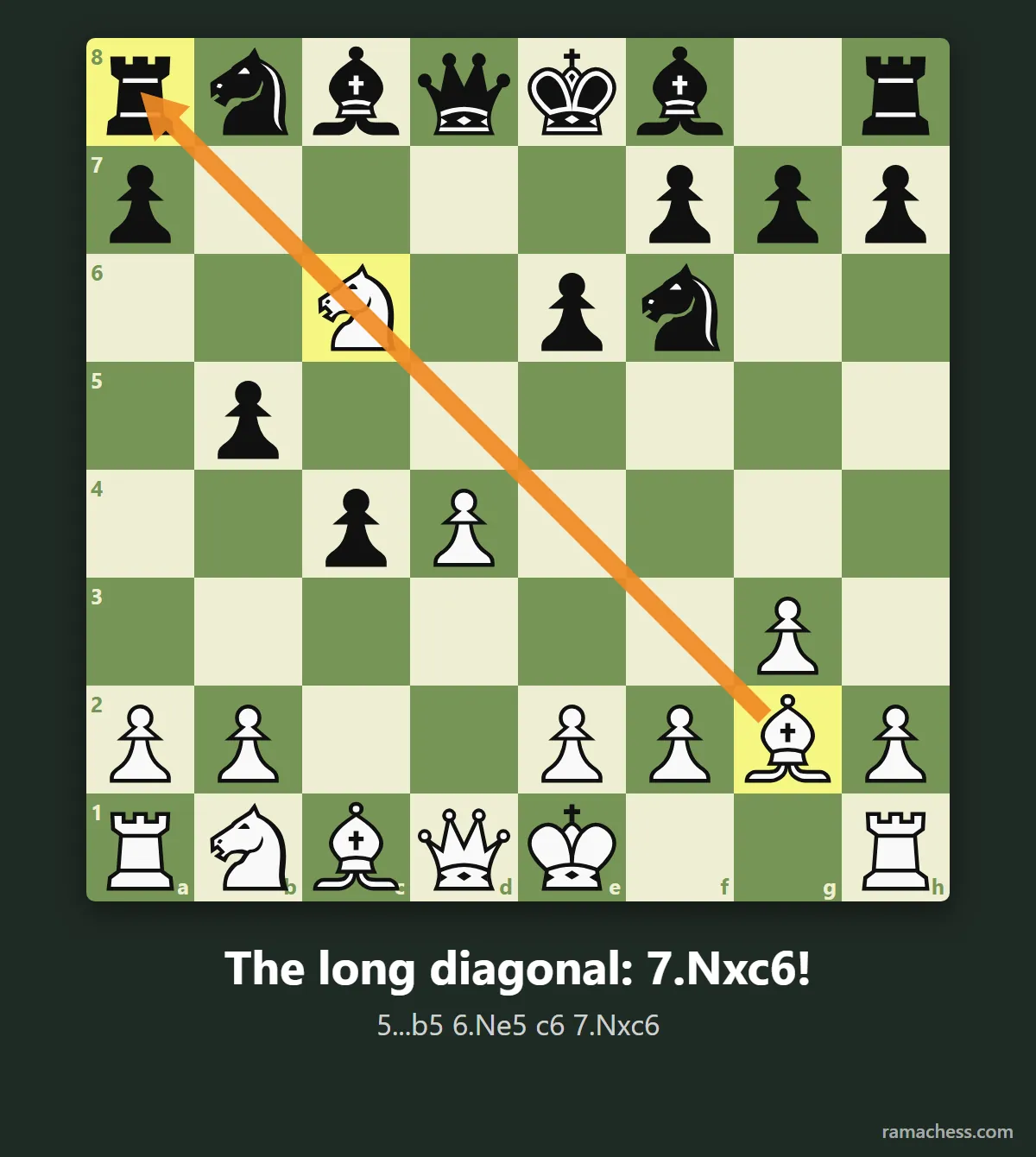
The long diagonal creates tactics all the time. Here is a typical one, checked with Stockfish. In the Open Catalan, if Black tries to hold the pawn too early with 5...b5, White hits back with 6.Ne5, threatening the rook on a8 through the long diagonal. After 6...c6 the shot 7.Nxc6! works, because 7...Nxc6? 8.Bxc6+ forks the king and the a8 rook. Stockfish 18 rates White clearly better after 7.Nxc6 (about +0.75).
- Pins on the long diagonal. A piece on c6 or b7 is often pinned to the a8 rook.
- Qa4+ to win c4 back. The check also attacks loose pieces on the queenside.
- ...Bb4+ for Black. Swapping the dark-squared bishops makes Black's game easier.
History: why is it called the Catalan?
The name comes from Catalonia. At the 1929 Barcelona tournament the organisers asked Savielly Tartakower to play a new opening in honour of the region, and he chose 1.d4 with an early g3. Similar positions had appeared a little earlier: a 1928 game Réti-Leonhardt in Berlin reached an Open Catalan by transposition.
Strong players such as Capablanca, Alekhine and Botvinnik used the Catalan in the 1930s and 1940s. In the 1983 Candidates semi-final between Garry Kasparov and Viktor Korchnoi, five of the eleven games were Catalans. (Sources: the Wikipedia article on the Catalan Opening and match records, checked 15 October 2026.)
Who plays the Catalan?
The Catalan is one of the most respected openings at the top. Vladimir Kramnik played it three times in the 2006 World Championship, and Viswanathan Anand used it four times against Veselin Topalov in 2010. Magnus Carlsen made it one of his main weapons in the late 2010s. See all of his games with it in Magnus Carlsen's Catalan games (every game, record and result, with a replay board). Top engines play it too: see our engine games in the Catalan.
Is it right for you? The Catalan suits patient players who like pressure without big risks. It needs good positional understanding, so it pays to learn the plans, not only the moves.
Practice the Catalan Opening in the Rama Chess trainer
Reading a guide is the first step. To make the moves stick, practise them. Our opening trainer has 29 Catalan Opening lines. Each one is checked with Stockfish. You watch the moves with arrows, replay them from memory, then take a test. The full set of lines is part of Rama Chess Premium.
Most lines in our trainer are the Closed Catalan (E06). Start there, then add the Open Catalan with 5.Nf3 (E04-E05). After training, play the opening against a chess bot and check your game in the free analyser.
See all our chess opening guides.
Catalan Opening FAQ
What are the moves of the Catalan Opening?
The Catalan starts with 1.d4 Nf6 2.c4 e6 3.g3, usually with 3...d5 4.Bg2 next.
Is the Catalan Opening good?
Yes. It is one of the most respected openings for White at every level, used in World Championship matches by Kramnik, Anand and Carlsen. Stockfish 18 gives White a small edge (about +0.25), the normal first-move advantage.
What is the difference between the Open and Closed Catalan?
In the Open Catalan Black takes the c4 pawn with ...dxc4 (E02-E05). In the Closed Catalan Black keeps the pawn on d5 and plays ...Be7 (E06-E09).
What is the best defence against the Catalan?
There is no refutation. The main tries are the Open Catalan (4...dxc4 with ...a6 and ...c5), the solid Closed Catalan (4...Be7 with ...c6 and ...b6) and 4...Bb4+ to swap bishops. All are fully sound.
Is the Catalan a gambit?
Not really. In the Open Catalan White often lets Black take the c4 pawn, but White can usually win it back with Qa4+, Qc2 or Ne5, so it is a temporary pawn offer, not a true gambit.
Why is it called the Catalan?
It is named after Catalonia. At the 1929 Barcelona tournament Savielly Tartakower was asked to play a new opening in honour of the region.
Is the Catalan good for beginners?
It is sound and safe, but its value is in long-term pressure, which is hard to use without experience. Beginners can learn it, but should study the plans as well as the moves.
Which world champions play the Catalan?
Vladimir Kramnik, Viswanathan Anand and Magnus Carlsen all used it in World Championship matches.
Where can I see Magnus Carlsen's Catalan games?
Our page Magnus Carlsen Catalan Opening games lists his games with this opening, with results and a replay board.
Watch on YouTube
Prefer video? Our channels show real games move by move, with clear explanations.
Ready to practise?
You know the ideas. Now train the moves until you play them without thinking.