Queen's Gambit Declined: Moves, Plans, Main Lines and Traps
The Queen's Gambit Declined is one of the oldest and most trusted answers to 1.d4. Black meets 1.d4 d5 2.c4 with 2...e6, holds the centre and gets a solid, healthy position. This guide shows the moves, the plans for both sides, the main variations with ECO codes, the famous Elephant Trap, and 130 lines you can train on Rama Chess.

What is the Queen's Gambit Declined?
The Queen's Gambit Declined (QGD) starts with 1.d4 d5 2.c4 e6. White offers the c4 pawn to pull Black's d5 pawn away from the centre. Black says no thanks. The e6 pawn supports d5, so Black keeps a strong point in the middle of the board.
It is not a real gambit: if Black takes on c4, White can usually win the pawn back. The point of 2.c4 is to fight for the centre. The QGD is the calm, classical answer. Black's position has no weak pawns, and the plan is easy to learn.
The price is one small problem: the e6 pawn blocks Black's light-squared bishop on c8. Much of QGD theory is about how Black frees that bishop. The QGD has the ECO codes D30 to D69, and it is played at every level, from club games to world championship matches.
The main ideas for both sides
Black's plans
- Hold d5. Pawns on d5 and e6, knights on f6 and d7, bishop on e7 and castle short. Simple and safe.
- Free the c8 bishop. Black does it with ...b6 and ...Bb7 (Tartakower), with ...dxc4 and ...e5, or with ...c5.
- Trade pieces. Black has a little less space, so exchanges help. The Lasker idea ...Ne4 is built on this.
- Break with ...c5 or ...e5. One of these breaks is usually needed to get full equality.
White's plans
- Pressure on d5. Nc3, the c4 pawn and often a bishop on g5 or f4 all aim at Black's centre.
- The minority attack. In the Exchange Variation White pushes b4-b5 to create a weak pawn on c6.
- Space and the e4 push. If White gets e4 in safely, the centre belongs to White.
- Keep Black's bishop locked. White tries to stop ...e5 and ...c5 for as long as possible.
Main variations of the Queen's Gambit Declined
Here are the lines you will meet most. Every move order below is checked move by move.
| Variation | ECO | Moves | Idea |
|---|---|---|---|
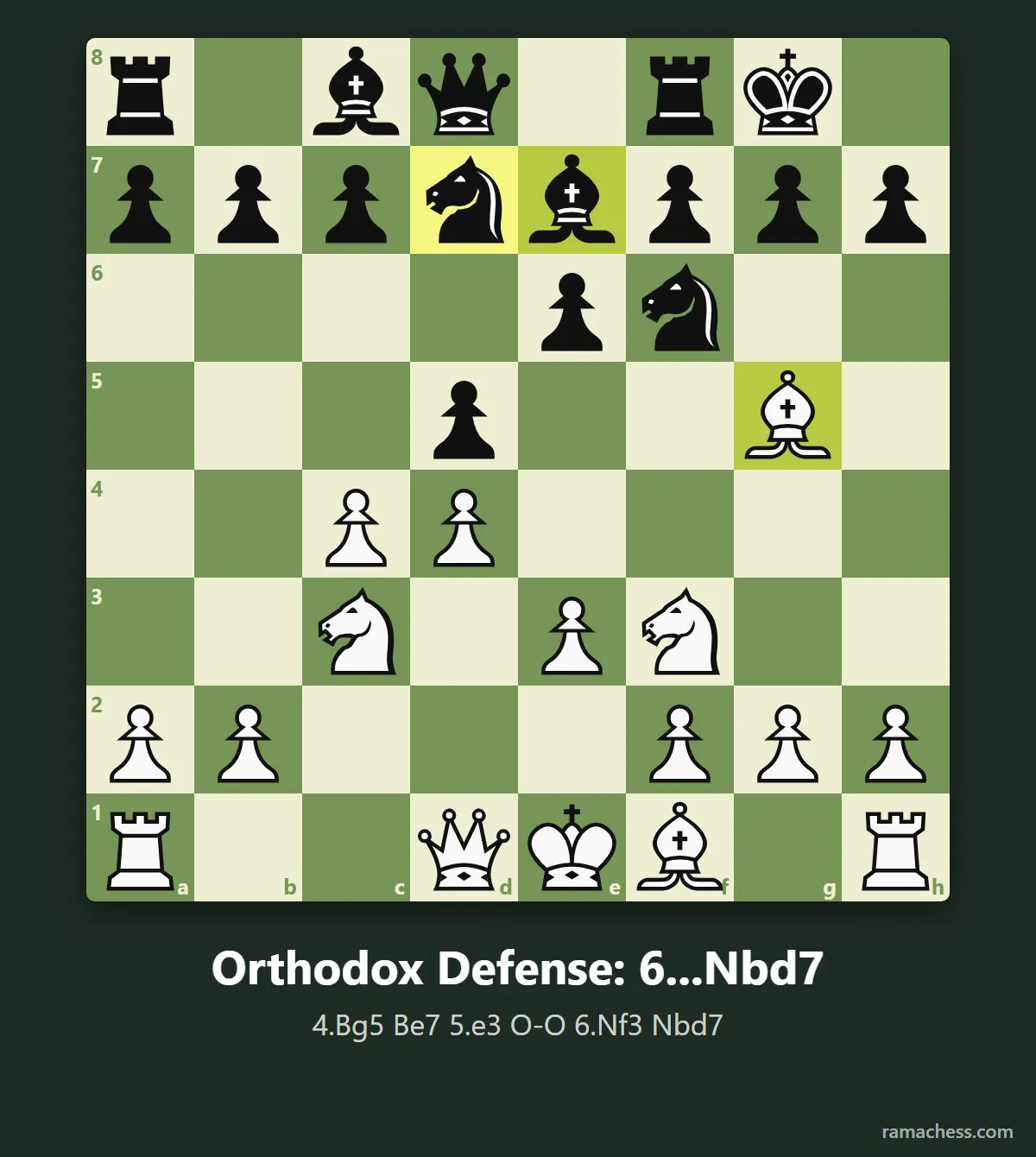
| Orthodox Defense | D60-D69 | 1.d4 d5 2.c4 e6 3.Nc3 Nf6 4.Bg5 Be7 5.e3 O-O 6.Nf3 Nbd7 | the classical main line |
| Exchange Variation | D35-D36 | 1.d4 d5 2.c4 e6 3.Nc3 Nf6 4.cxd5 exd5 | fixed structure; White often plays a minority attack |
| Harrwitz Attack (5.Bf4) | D37 | 1.d4 d5 2.c4 e6 3.Nc3 Nf6 4.Nf3 Be7 5.Bf4 | modern main line: the bishop goes to f4, not g5 |
| Tartakower Variation | D58-D59 | 1.d4 d5 2.c4 e6 3.Nc3 Nf6 4.Bg5 Be7 5.e3 O-O 6.Nf3 h6 7.Bh4 b6 | ...b6 and ...Bb7 solve the bishop problem |
| Lasker Defense | D56-D57 | 1.d4 d5 2.c4 e6 3.Nc3 Nf6 4.Bg5 Be7 5.e3 O-O 6.Nf3 h6 7.Bh4 Ne4 | trades pieces to free Black |
| Cambridge Springs | D52 | 1.d4 d5 2.c4 e6 3.Nc3 Nf6 4.Bg5 Nbd7 5.e3 c6 6.Nf3 Qa5 | the queen pins the c3 knight |
| Ragozin | D38-D39 | 1.d4 d5 2.c4 e6 3.Nc3 Nf6 4.Nf3 Bb4 | a Nimzo-Indian style bishop on b4 |
| Semi-Tarrasch | D40-D42 | 1.d4 d5 2.c4 e6 3.Nc3 Nf6 4.Nf3 c5 | Black hits the centre at once |
| Tarrasch Defense | D32-D34 | 1.d4 d5 2.c4 e6 3.Nc3 c5 | free play for an isolated d-pawn |
| Semi-Slav | D43-D49 | 1.d4 d5 2.c4 e6 3.Nc3 Nf6 4.Nf3 c6 | ...c6 and ...e6 together; very sharp |
The Orthodox Defense is the old main line: 3.Nc3 Nf6 4.Bg5 Be7 5.e3 O-O 6.Nf3 Nbd7. Capablanca's freeing idea was ...dxc4 followed by ...Nd5, trading pieces to make room.
5.Bf4 is the modern favourite of many top players. After 3.Nc3 Nf6 4.Nf3 Be7 5.Bf4 O-O 6.e3 the bishop avoids being traded by ...Ne4 or ...h6. It has more lines in our trainer than any other QGD system.
The Exchange Variation (3.Nc3 Nf6 4.cxd5 exd5) fixes the pawns. White often castles short and plays the minority attack with b4-b5, or castles long and attacks the king.
The Elephant Trap and typical tactics
Want every trap on its own board? See Queen's Gambit Traps: 3 Tricks That Win the Queen or a Rook - the Elephant Trap, the Lasker Trap and a trap for White in the Accepted, with real game stats.
The most famous trap in the QGD is the Elephant Trap. It is checked with Stockfish:
After 1.d4 d5 2.c4 e6 3.Nc3 Nf6 4.Bg5 Nbd7 5.cxd5 exd5 the f6 knight is pinned to the queen on d8, so the d5 pawn looks free. It is not. If White grabs the pawn with 6.Nxd5?, Black answers 6...Nxd5!. Now 7.Bxd8 Bb4+ 8.Qd2 Bxd2+ 9.Kxd2 Kxd8 leaves Black a whole piece up. Stockfish rates the position after 6...Nxd5 as more than three pawns better for Black.
Typical tactics to know:
- ...Ne4 tricks. The knight jump to e4 trades pieces and can hit c3 and g5 at the same time.
- Bxf6 and the d5 pawn. When White takes on f6, check if the d5 pawn is still defended.
- The b-file in the Exchange. After b4-b5 and bxc6, the c6 pawn becomes a target for White's rooks.

Who plays the Queen's Gambit Declined?
The QGD has been a favourite of world champions for more than a century. José Raúl Capablanca and Alexander Alekhine played it in their 1927 World Championship match. Viswanathan Anand chose the Lasker Defense in the final game of his 2010 match against Veselin Topalov, and Magnus Carlsen beat Boris Gelfand with the Cambridge Springs at the 2013 Candidates. Today it is still one of the most respected defences at the top level, and engines play it often too: see our engine games in the QGD.
Is it right for you? If you want a solid answer to 1.d4 with clear plans and few early tactics, the QGD is an excellent choice. If you want a sharper game, look at the Slav Defense or the Semi-Slav.
Practice the Queen's Gambit Declined in the Rama Chess trainer
Reading a guide is the first step. To make the moves stick, practise them. Our opening trainer has 130 Queen's Gambit Declined lines. Each one is checked with Stockfish. You watch the moves with arrows, replay them from memory, then take a test. The full set of lines is part of Rama Chess Premium.
Good first steps are the 5.Bf4 lines (D37) and the Semi-Slav (D43-D45), because they are the most common in modern games.
See all our chess opening guides.
Queen's Gambit Declined FAQ
What are the moves of the Queen's Gambit Declined?
The QGD starts with 1.d4 d5 2.c4 e6. Black supports the d5 pawn with ...e6 instead of taking on c4.
Is the Queen's Gambit really a gambit?
Not really. If Black takes on c4, White can usually win the pawn back. The aim of 2.c4 is to pull Black's d-pawn away from the centre.
What is the Elephant Trap?
It is a trap in the QGD: 1.d4 d5 2.c4 e6 3.Nc3 Nf6 4.Bg5 Nbd7 5.cxd5 exd5 6.Nxd5 Nxd5 7.Bxd8 Bb4+ 8.Qd2 Bxd2+ 9.Kxd2 Kxd8, and Black wins a piece.
What is the main problem for Black in the QGD?
The light-squared bishop on c8 is blocked by the e6 pawn. Black frees it with ...b6 and ...Bb7, or with the pawn breaks ...c5 and ...e5.
Is the Queen's Gambit Declined good for beginners?
Yes. It is solid, follows the opening principles and has clear plans. It is a good first defence against 1.d4.
Which ECO codes cover the QGD?
The QGD is D30 to D69. For example the Tarrasch is D32-D34, the Ragozin D38-D39, the Semi-Slav D43-D49 and the Orthodox Defense D60-D69.
Watch on YouTube
Prefer video? Our channels show real games move by move, with clear explanations.
Ready to practise?
You know the ideas. Now train the moves until you play them without thinking.