Reti Opening (1.Nf3) and Larsen's 1.b3: Moves and Plans
The Reti Opening starts with 1.Nf3 and, in its classic form, 1.Nf3 d5 2.c4. White attacks the centre from the side instead of occupying it. This page also covers the related Nimzo-Larsen Attack, 1.b3, which our trainer keeps in the same folder.

What is the Reti Opening?
The Reti Opening is named after Richard Reti (1889-1929), a Czechoslovak master who was one of the leaders of the "hypermodern" school. The hypermodern idea is simple: you do not need pawns in the centre at once. You can control the centre from a distance with knights, the c-pawn and fianchettoed bishops, and attack the centre later.
In its classic form the Reti goes 1.Nf3 d5 2.c4, with g3 and Bg2 to follow. Today the name is used mainly for set-ups with Nf3 and c4 against ...d5 where White does not play an early d4. The wider 1.Nf3 family has the ECO codes A04 to A09, and the classic 2.c4 line is A09.
Reti's most famous win with it came against world champion Jose Raul Capablanca at New York 1924. Much later, Gukesh used the Reti in game 11 of the 2024 World Championship against Ding Liren and won an important game.
The main ideas for both sides
White's plans
- Pressure on d5. The c4 pawn, the g2 bishop and often a queen on b3 or a4 all attack d5.
- Stay flexible. White can later choose d4 (Queen's Gambit or Catalan), d3 and e4 (King's Indian Attack style), or b3 and Bb2 (a double fianchetto).
- Transpositions. Many Reti games turn into an English or a Catalan. Knowing those openings helps a lot.
Black's plans
- Hold d5 with ...e6 or ...c6 and reach a solid Queen's Gambit type of position.
- Push past with 2...d4 and take space, like a Benoni with colours reversed.
- Take the pawn with 2...dxc4. White usually wins it back with e3, Qa4+ or Na3.
Main lines of the Reti
Here are the main ways the game goes after 1.Nf3. All move orders are checked.
| Variation | ECO | Moves | Idea |
|---|---|---|---|
| Reti, classic | A09 | 1.Nf3 d5 2.c4 | White hits d5 with the c-pawn |
| Reti, 2...d4 | A09 | 1.Nf3 d5 2.c4 d4 | a reversed Benoni: Black takes space |
| Reti, 2...dxc4 | A09 | 1.Nf3 d5 2.c4 dxc4 | White regains the pawn with e3 or Qa4+ |
| Reti, 2...e6 / 2...c6 | A09 and others | 1.Nf3 d5 2.c4 e6 | often turns into a Queen's Gambit or Catalan |
| 1.Nf3 c5 (Symmetrical) | A04 | 1.Nf3 c5 2.c4 | usually an English Symmetrical |
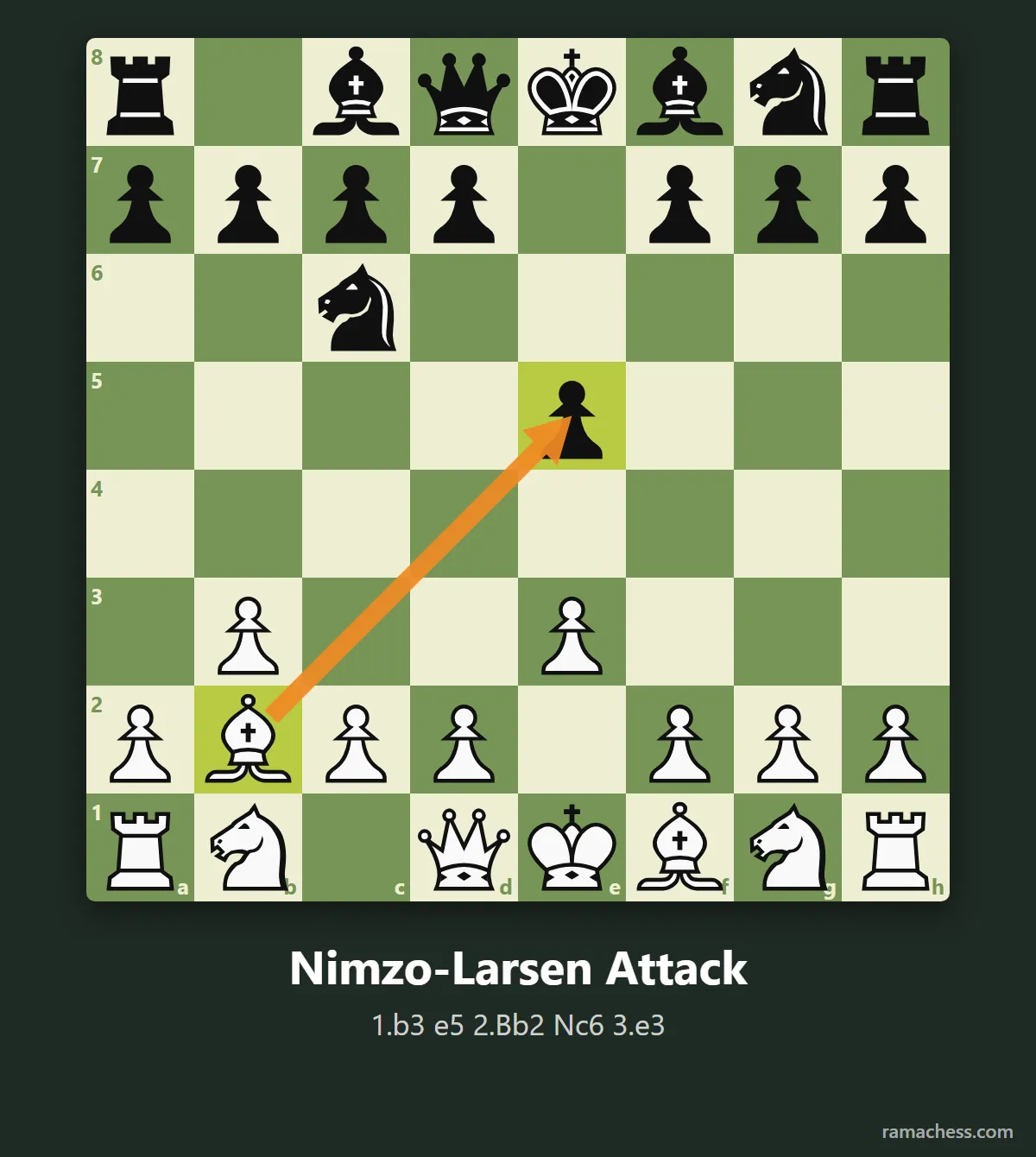
| Nimzo-Larsen Attack | A01 | 1.b3 e5 2.Bb2 Nc6 | the bishop on b2 hits e5 at once |
After 1.Nf3 d5 2.c4 d4 White often plays 3.e3 to open the centre, or the sharp 3.b4 to grab queenside space. After 1.Nf3 d5 2.c4 e6 3.g3 Nf6 4.Bg2 the game is close to a Catalan.
Our trainer lines for 1.Nf3 here start with 1.Nf3 c5 2.c4 Nc6 3.Nc3 g6: a Symmetrical English reached by the Reti move order. More 1.Nf3 lines are in the King's Indian Attack and English Opening guides.
The Nimzo-Larsen Attack: 1.b3
1.b3 is named after Aron Nimzowitsch and Bent Larsen. Larsen played it often from 1968 to 1972, and Bobby Fischer also used it a few times in 1970. Its ECO code is A01.
The bishop goes to b2 and looks down the long diagonal at e5, f6, g7 and h8. Against 1.b3 e5 2.Bb2 Nc6 White usually plays 3.e3 or 3.c4, then Bb5 to hit the knight that guards e5. The plan is to win the e5 pawn or force Black to defend it with awkward moves.
Black can answer in many sound ways. With ...d5, ...Nc6 and ...Bd6 Black builds a big centre; this is a common, direct plan. 1.b3 is not without risk: Larsen lost a famous 17-move game to Boris Spassky with it in 1970.
A simple trap and typical tactics
In the Larsen, Black must remember that e5 is attacked from move two. After 1.b3 e5 2.Bb2, a careless 2...Nf6? just drops a pawn to 3.Bxe5. Stockfish gives White about a one-pawn edge there. Defend e5 first with ...Nc6 or ...d6.
Typical tactics in the Reti:
- Qa4+ and Qxc4. After ...dxc4, a queen check on a4 often wins the pawn back at once.
- The long diagonals. With bishops on g2 and b2, a piece that moves away from b7 or e5 can expose a rook or a pawn.
- cxd5 at the right moment. Taking on d5 can open the c-file for a white rook.
Practice the Reti Opening in the Rama Chess trainer
Reading a guide is the first step. To make the moves stick, practise them. Our opening trainer has 7 Reti Opening lines. Each one is checked with Stockfish. You watch the moves with arrows, replay them from memory, then take a test. The full set of lines is part of Rama Chess Premium.
The trainer has a few lines: 1.Nf3 lines that become a Symmetrical English (A04) and 1.b3 lines (A01). Then try the King's Indian Attack guide for more 1.Nf3 lines.
See all our chess opening guides.
Reti Opening FAQ
What is the Reti Opening?
It is 1.Nf3 d5 2.c4 in its classic form. White controls the centre from the side with the knight, the c-pawn and a bishop on g2. It is named after Richard Reti.
Is the Reti Opening good?
Yes. It is played at the very top; Gukesh used it to win game 11 of the 2024 World Championship. It is flexible and avoids a lot of main-line theory.
What is the best reply to 1.Nf3?
Many moves are good. 1.Nf3 d5, 1.Nf3 Nf6 and 1.Nf3 c5 are the most common, and each can lead to very different positions.
What is the Nimzo-Larsen Attack?
It is the opening 1.b3 (ECO A01), named after Aron Nimzowitsch and Bent Larsen. White fianchettoes the queen's bishop at once.
What ECO codes cover the Reti?
The 1.Nf3 openings are A04 to A09. The classic Reti with 1.Nf3 d5 2.c4 is A09.
Is 1.Nf3 good for beginners?
It is safe, but its power comes from understanding plans and transpositions. Beginners can play it, but 1.e4 or 1.d4 teach basic opening principles faster.
Watch on YouTube
Prefer video? Our channels show real games move by move, with clear explanations.
Ready to practise?
You know the ideas. Now train the moves until you play them without thinking.