King's Indian Defense: Moves, Plans, Main Lines and Tactics
The King's Indian is the fighting answer to 1.d4. Black lets White build a big pawn centre, hides the king behind a fianchettoed bishop on g7, and then strikes back with 6...e5 or ...c5. This guide explains the moves, the plans for both sides, the main variations with ECO codes, one classic trick and the 58 King's Indian lines you can train on Rama Chess.

What is the King's Indian Defense?
The King's Indian starts with 1.d4 Nf6 2.c4 g6 3.Nc3 Bg7 4.e4 d6. Black does not fight for the centre with pawns at once. Instead, Black puts the bishop on g7, castles, and waits for the right moment to hit the centre with ...e5 or ...c5.
This is a "hypermodern" idea: let White take space, then attack that space. The White centre on c4, d4 and e4 looks strong, but it can also become a target. The King's Indian has the ECO codes E60 to E99.
Until the mid-1930s many strong players thought the opening was too risky for Black. Soviet players then worked out its ideas, and it became one of the most respected and most exciting defences in chess.
The main ideas for both sides
Black's plans
- Strike with ...e5. The main idea. If White closes the centre with d5, Black plays on the kingside.
- The kingside pawn storm. With the centre locked, Black plays ...Ne8 or ...Nd7, then ...f5, ...f4 and ...g5, and throws everything at White's king. Many King's Indian games are won with a direct mating attack.
- The g7 bishop. It looks blocked by Black's own e5 pawn, but if the long diagonal opens it becomes very strong.
- ...c5 or ...c6 and ...b5. In some lines Black plays on the queenside instead, as in a Benoni.
White's plans
- Use the space. White has more room and can play on the queenside with b4, c5 and Nd2-c4 to break open the c-file.
- Close the centre with d5, then race. Speed is everything: White wants to open the queenside before Black's kingside attack lands.
- Stop the attack. In the Samisch, the f3 pawn makes ...f5 less dangerous, and White can castle long and attack Black's king instead.
Main variations of the King's Indian
White has many systems against the King's Indian. These are the ones you will meet most. Each move order below is checked move by move.
| Variation | ECO | Moves | Idea |
|---|---|---|---|
| Classical | E91-E99 | 1.d4 Nf6 2.c4 g6 3.Nc3 Bg7 4.e4 d6 5.Nf3 O-O 6.Be2 e5 | the main line; Black strikes at d4 at once |
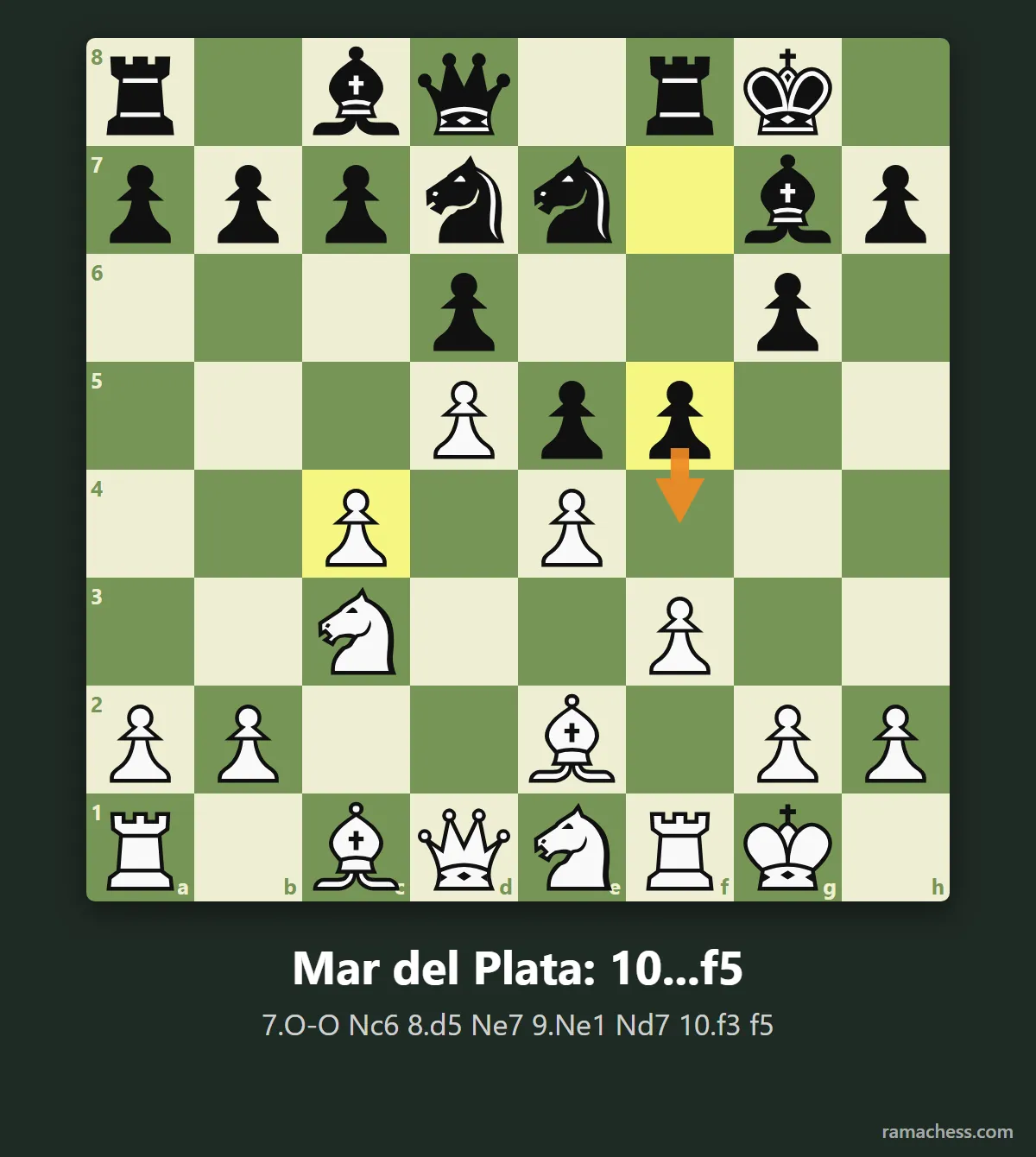
| Mar del Plata | E99 | 1.d4 Nf6 2.c4 g6 3.Nc3 Bg7 4.e4 d6 5.Nf3 O-O 6.Be2 e5 7.O-O Nc6 8.d5 Ne7 9.Ne1 Nd7 10.f3 f5 | race: White on the queenside, Black on the kingside |
| Bayonet Attack | E97 | 1.d4 Nf6 2.c4 g6 3.Nc3 Bg7 4.e4 d6 5.Nf3 O-O 6.Be2 e5 7.O-O Nc6 8.d5 Ne7 9.b4 | White starts the queenside attack at once |
| Petrosian | E93 | 1.d4 Nf6 2.c4 g6 3.Nc3 Bg7 4.e4 d6 5.Nf3 O-O 6.Be2 e5 7.d5 | White closes the centre early |
| Samisch | E80-E89 | 1.d4 Nf6 2.c4 g6 3.Nc3 Bg7 4.e4 d6 5.f3 | f3, Be3, Qd2 and often long castling |
| Four Pawns Attack | E76-E79 | 1.d4 Nf6 2.c4 g6 3.Nc3 Bg7 4.e4 d6 5.f4 | a huge centre; Black hits back with ...c5 |
| Averbakh | E73-E75 | 1.d4 Nf6 2.c4 g6 3.Nc3 Bg7 4.e4 d6 5.Be2 O-O 6.Bg5 | the bishop stops ...e5 ideas for a while |
| Makogonov | E71 | 1.d4 Nf6 2.c4 g6 3.Nc3 Bg7 4.e4 d6 5.h3 | h3 and Be3, keeping g4 ready |
| Fianchetto | E62-E69 | 1.d4 Nf6 2.c4 g6 3.Nf3 Bg7 4.g3 | quiet and positional |
The Classical (5.Nf3 O-O 6.Be2 e5) is the main battlefield. After 7.O-O Nc6 8.d5 Ne7 White chooses between 9.Ne1, which leads to the famous Mar del Plata, and the sharp Bayonet Attack with 9.b4.
The Samisch (5.f3) is White's most aggressive set-up. The f3 pawn protects e4 and prepares Be3, Qd2 and often g4 and h4. Black usually answers with ...c5, ...e5 or the queenside plan with ...a6, ...c6 and ...b5.
The Four Pawns Attack (5.f4) grabs the most space of all. It is risky for White, because the pawns can become targets after 5...O-O 6.Nf3 c5.
The Fianchetto Variation (with g3 and Bg2) is the calm way. White puts the bishop on the long diagonal too, so Black's kingside attack is much harder.
A classic trick and typical tactics
The Exchange line looks harmless, but it hides a trick that surprises many club players. After 1.d4 Nf6 2.c4 g6 3.Nc3 Bg7 4.e4 d6 5.Nf3 O-O 6.Be2 e5 7.dxe5 dxe5 8.Qxd8 Rxd8 White may think the e5 pawn is free: 9.Nxe5. But Black answers 9...Nxe4! and wins the pawn straight back: after 10.Nxe4 Bxe5 the g7 bishop takes on e5 and then eyes b2 on the long diagonal. We checked it with Stockfish: the position is equal, so White's "free pawn" won nothing. The lesson: once the e5 pawn is gone, White's e4 pawn is often loose.
Typical tactics to know:
- The long diagonal. When the e5 pawn disappears, the g7 bishop suddenly attacks b2, c3 and a1.
- Sacrifices on g3 and h3. In the race lines, Black often gives a piece to open White's king.
- c5 and Nb5 break-ins. White's queenside attack aims at c7, the weak square in Black's camp.
Who plays the King's Indian?
The King's Indian has been played by many world champions. Mikhail Tal, Bobby Fischer and Garry Kasparov all used it to win famous attacking games. Kasparov played it for most of his career and only gave it up after Vladimir Kramnik scored very well against it in the early 2000s. In the modern game, Hikaru Nakamura, Teimour Radjabov and Ding Liren are well known King's Indian players. You can watch engines fight with it in our engine games in the King's Indian.
Is it right for you? Play the King's Indian if you like sharp games, a kingside attack and taking risks to win with Black. If you prefer a solid, classical game against 1.d4, look at the Queen's Gambit Declined or the Nimzo-Indian.
Practice the King's Indian Defense in the Rama Chess trainer
Reading a guide is the first step. To make the moves stick, practise them. Our opening trainer has 58 King's Indian Defense lines. Each one is checked with Stockfish. You watch the moves with arrows, replay them from memory, then take a test. The full set of lines is part of Rama Chess Premium.
A good start is the Classical (E92 to E99) and the Samisch (E81 to E89), because they are the most common at every level.
See all our chess opening guides.
King's Indian Defense FAQ
What are the moves of the King's Indian Defense?
The main position comes after 1.d4 Nf6 2.c4 g6 3.Nc3 Bg7 4.e4 d6. Black usually castles next and then plays ...e5 or ...c5.
Is the King's Indian Defense good?
Yes. It is a fully sound defence that has been played by world champions such as Tal, Fischer and Kasparov. It is sharp and risky, so it suits players who like to fight.
What is the Mar del Plata variation?
It is the main line of the Classical King's Indian: 1.d4 Nf6 2.c4 g6 3.Nc3 Bg7 4.e4 d6 5.Nf3 O-O 6.Be2 e5 7.O-O Nc6 8.d5 Ne7 9.Ne1 Nd7 10.f3 f5. The centre is closed and both sides attack on opposite wings.
What is the best system for White against the King's Indian?
There is no single best one. The Classical with 5.Nf3 and 6.Be2 is the most popular. The Samisch (5.f3) is the most aggressive, and the Fianchetto (g3) is the safest.
Is the King's Indian good for beginners?
It is easy to start, because Black's first moves are simple: Nf6, g6, Bg7, d6 and castle. The middlegames are sharp, so learn the main plans before you play it in serious games.
What is the difference between the King's Indian Defense and the King's Indian Attack?
The King's Indian Defense is played by Black against 1.d4. The King's Indian Attack is a set-up for White with Nf3, g3, Bg2, O-O, d3 and e4.
Watch on YouTube
Prefer video? Our channels show real games move by move, with clear explanations.
Ready to practise?
You know the ideas. Now train the moves until you play them without thinking.