The Sicilian Defense: A Complete Guide
The Sicilian Defense (also spelled Sicilian Defence), 1.e4 c5, is the most popular answer to 1.e4 in master chess. It gives Black an unbalanced game and real winning chances. This guide maps the whole opening for you: the idea, every main variation, the Sicilian attacks, the White sidelines and the plans, with exact diagrams.

- What is the Sicilian Defense?
- The Open Sicilian: White's main line
- The Najdorf and the Dragon
- The Scheveningen and the Classical
- Lines with 2...Nc6: the Sveshnikov and the Accelerated Dragon
- Lines with 2...e6: the Taimanov and the Kan
- The anti-Sicilians: White's sidelines
- Sicilian attacks: White's sharpest systems
- Typical plans in the Sicilian
- How to learn the Sicilian
- Frequently asked questions
What is the Sicilian Defense?
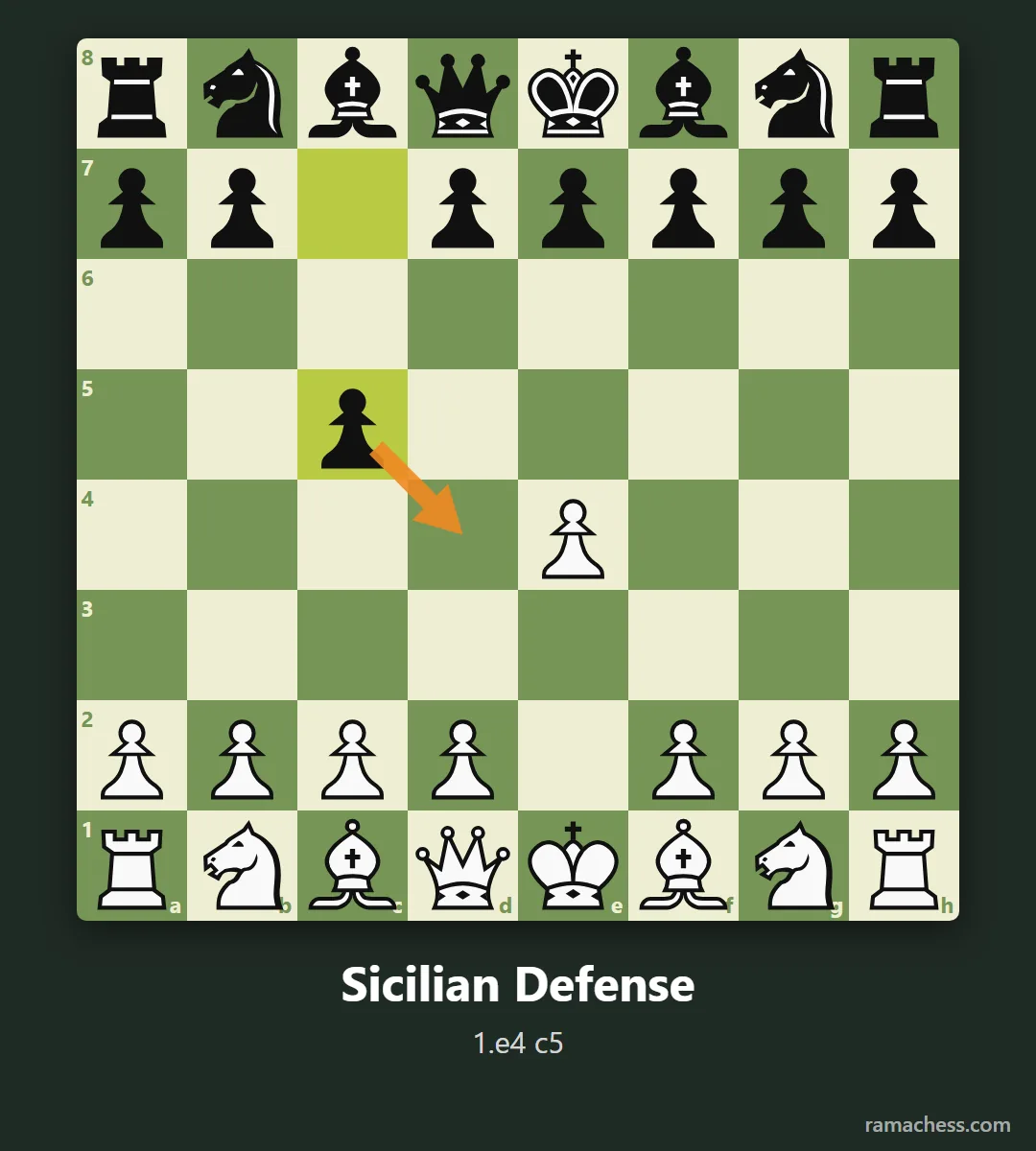
The Sicilian Defense starts with 1.e4 c5. Instead of answering 1.e4 with the symmetrical 1...e5, Black uses the c-pawn to control the d4-square from the side. It belongs to the ECO codes B20 to B99, a large part of all the "B" codes, which tells you how big this opening is.
Why 1...c5 works
The key moment comes when White plays d4. In the main lines Black captures, 1.e4 c5 2.Nf3 d6 3.d4 cxd4 4.Nxd4, and now the pawn structure is unequal:
- Black has traded a side pawn (c-pawn) for a centre pawn (d-pawn). Black still has two centre pawns (d and e), White has only one (e).
- Black gets a half-open c-file for the rook and queen, aimed at White's queenside.
- White gets a lead in development and more space, and often attacks Black's king.
So both sides have trumps. That imbalance is why the Sicilian leads to fighting games, and why players who want to win with Black love it.
The Open Sicilian: White's main line
The Open Sicilian is White's most direct answer: Nf3, then d4, and the knight takes back on d4. The most important position comes after:
1.e4 c5 2.Nf3 d6 3.d4 cxd4 4.Nxd4 Nf6 5.Nc3
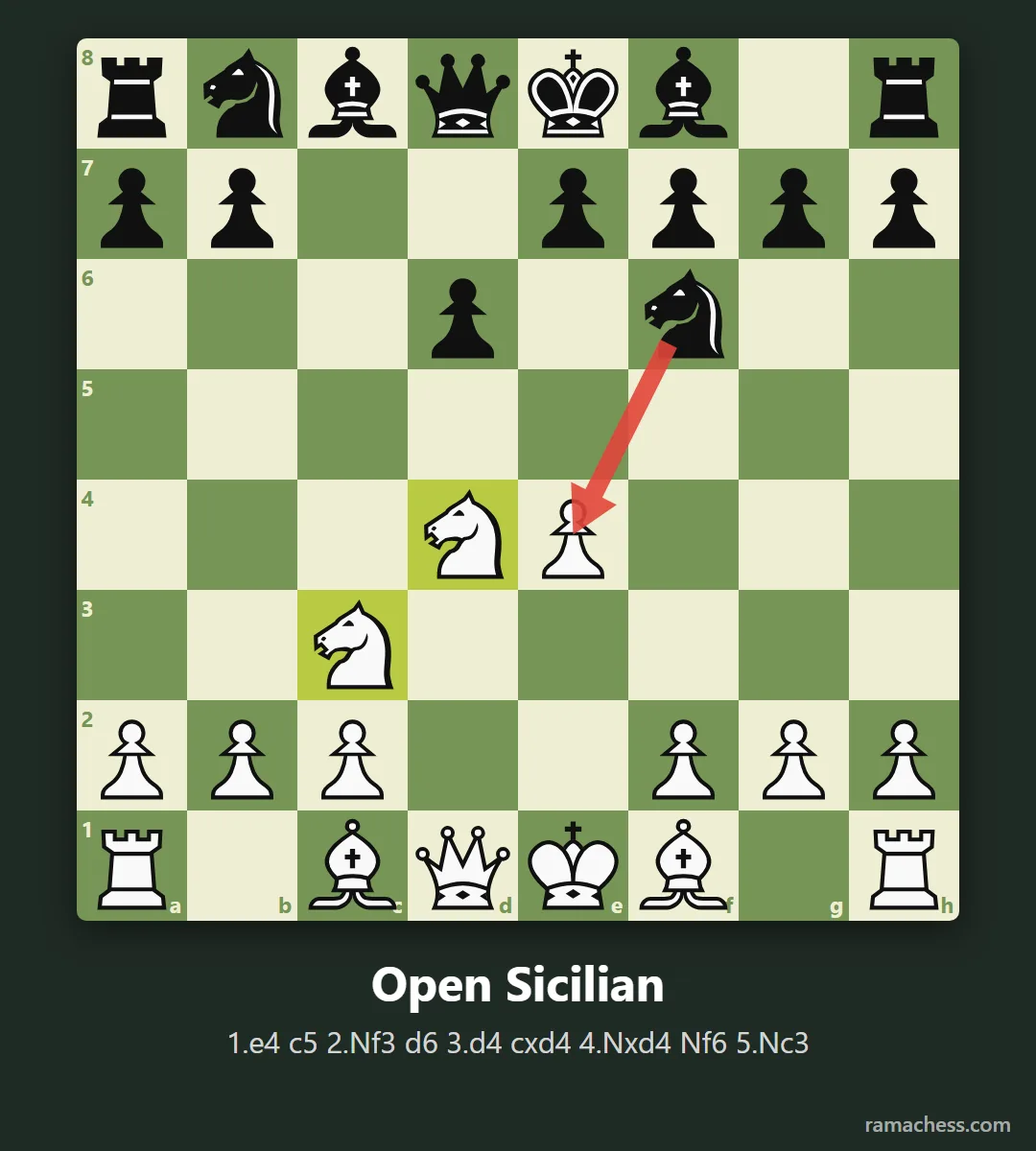
From this one position come four of the most famous variations in chess. Black can also reach other systems by playing 2...Nc6 or 2...e6 instead of 2...d6. The sections below go through each of them.
The Najdorf and the Dragon
The Najdorf: 5...a6
Named after the Polish-Argentine grandmaster Miguel Najdorf, 1.e4 c5 2.Nf3 d6 3.d4 cxd4 4.Nxd4 Nf6 5.Nc3 a6 is the most famous line of the Sicilian (ECO B90 to B99). The quiet move ...a6 keeps White's pieces off b5 and prepares ...e5 or ...b5. Black waits to see White's plan before choosing a set-up. It was the main weapon of world champions Bobby Fischer and Garry Kasparov.
White has many answers: 6.Be3 (the English Attack, often with f3, Qd2 and g4), 6.Bg5, 6.Be2, 6.Bc4 and 6.h3 are all popular. The theory is huge, so start with one line for each side and learn the ideas.
The Dragon: 5...g6
1.e4 c5 2.Nf3 d6 3.d4 cxd4 4.Nxd4 Nf6 5.Nc3 g6 puts the bishop on g7, where it bites along the long diagonal towards White's queenside (ECO B70 to B79). The Russian master Fyodor Dus-Chotimirsky later said that he gave it the name, because Black's pawn shape reminded him of the Draco (dragon) star group.

Against the Dragon, White's most dangerous plan is the Yugoslav Attack: Be3, f3, Qd2, castle queenside, then push the h-pawn to open the h-file against Black's king. Black attacks on the queenside at the same time. Games are often a pure race. Practise in our Najdorf trainer and Dragon trainer.
The Scheveningen and the Classical
Scheveningen: 1.e4 c5 2.Nf3 d6 3.d4 cxd4 4.Nxd4 Nf6 5.Nc3 e6 (ECO B80 to B89). It is named after a 1923 tournament in Scheveningen, in the Netherlands. Black builds a small, compact centre with pawns on d6 and e6. It looks modest, but it is very hard to break, and Black can strike back later with ...d5 or ...e5. White's sharpest try is the Keres Attack, 6.g4.
Classical: 1.e4 c5 2.Nf3 d6 3.d4 cxd4 4.Nxd4 Nf6 5.Nc3 Nc6. Black simply develops the second knight. A main answer for White is 6.Bg5, the Richter-Rauzer Attack, which aims to double Black's f-pawns or attack with queenside castling.

Train these in the Scheveningen trainer, the Classical Sicilian trainer and the Richter-Rauzer trainer.
Lines with 2...Nc6: the Sveshnikov and the Accelerated Dragon
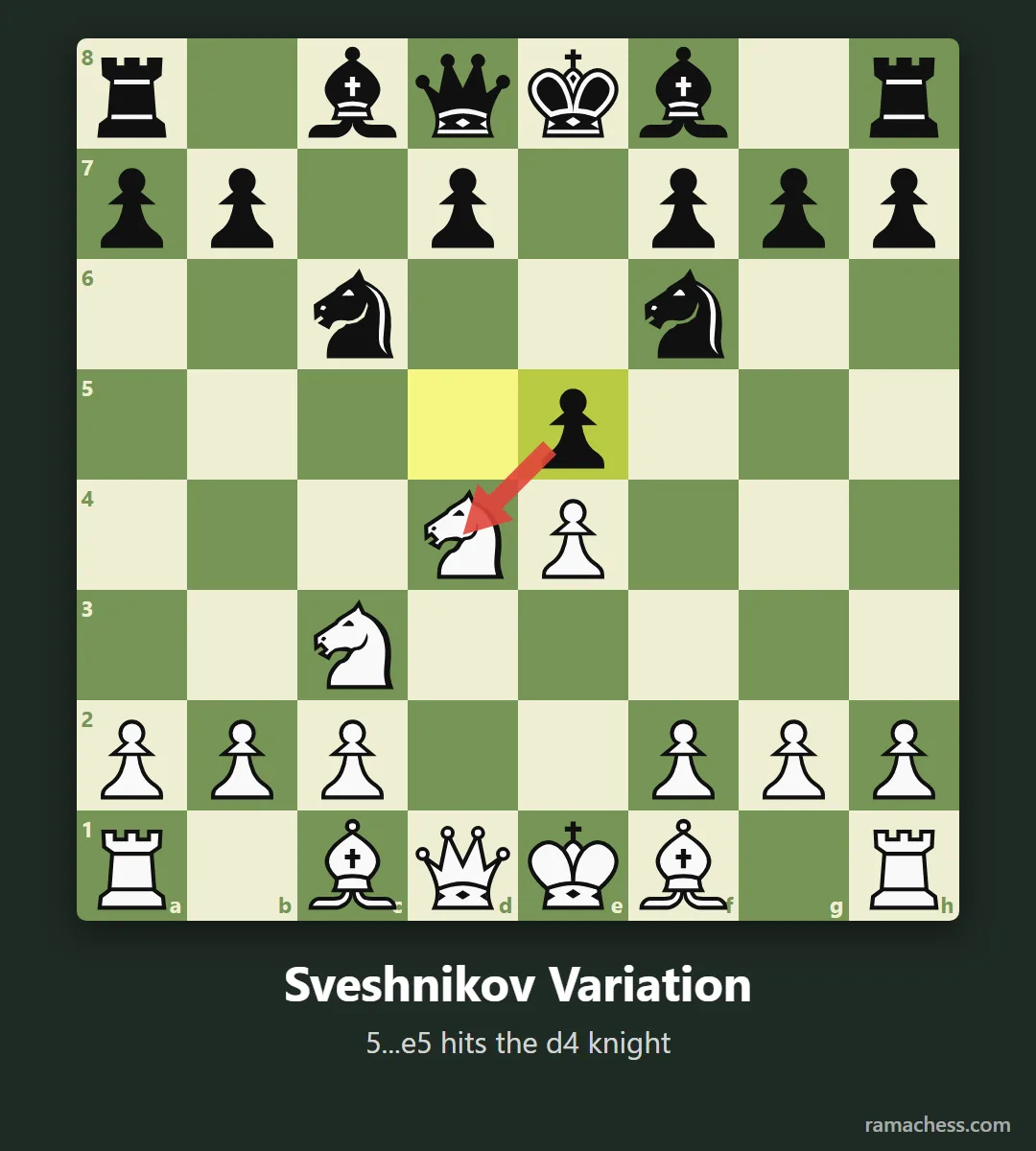
The Sveshnikov: 5...e5
1.e4 c5 2.Nf3 Nc6 3.d4 cxd4 4.Nxd4 Nf6 5.Nc3 e5 (ECO B33). Black kicks the knight from d4 at once and accepts a permanent "hole" on d5 and a backward d-pawn. In return Black gets fast, active piece play and often the bishop pair. It used to be called the Lasker-Pelikan; it was made popular by the Russian grandmaster Evgeny Sveshnikov. Magnus Carlsen used it as Black in his 2018 world championship match against Fabiano Caruana.
The Accelerated Dragon: 4...g6
1.e4 c5 2.Nf3 Nc6 3.d4 cxd4 4.Nxd4 g6. Black goes for the Dragon set-up but without ...d6 first. The idea is to play ...d5 in one move later, saving time. White's main positional answer is the Maroczy Bind with c4, which grips the d5-square. Practise both in the Accelerated Dragon trainer.
Lines with 2...e6: the Taimanov and the Kan
The Sicilian Defense, French Variation (2...e6)
The move 1.e4 c5 2.Nf3 e6 is called the French Variation of the Sicilian in opening databases (ECO B40), because the pawn on e6 looks like the French Defence (1.e4 e6). It is a flexible move order: Black can choose the Taimanov, the Kan, the Four Knights or even a Scheveningen later. If White does not play 3.d4, Black can sometimes reach real French-style positions with ...d5.
After 1.e4 c5 2.Nf3 e6 3.d4 cxd4 4.Nxd4 Black keeps the d-pawn flexible. It can go to d6 or straight to d5 later.
- Taimanov: 4...Nc6, named after Mark Taimanov. Black develops and often follows with ...Qc7 and ...a6.
- Kan (Paulsen): 4...a6, named after Ilya Kan. Even more flexible: Black delays developing the knights and keeps every option open.

These lines are a good choice if you like the Sicilian but want less forcing theory than the Najdorf or the Dragon. See the Taimanov and Kan trainer.
The anti-Sicilians: White's sidelines
Many White players do not want to enter the long theory of the Open Sicilian. They choose an "anti-Sicilian" instead. As a Sicilian player you must have an answer to each of them.
Alapin (2.c3) and Smith-Morra Gambit (2.d4 cxd4 3.c3)
The Alapin, 1.e4 c5 2.c3 (ECO B22), prepares d4 so that White can recapture with a pawn and keep a full centre. It is named after Semyon Alapin. Black's two main answers are 2...d5 and 2...Nf6.
The Smith-Morra Gambit, 1.e4 c5 2.d4 cxd4 3.c3, offers a pawn. If Black takes on c3, White gets fast development and open files. It is named after Ken Smith of the USA and Pierre Morra of France. It is dangerous in fast games, but Black is fine with careful play.

Rossolimo (3.Bb5) and Moscow (3.Bb5+)
The Rossolimo, 1.e4 c5 2.Nf3 Nc6 3.Bb5, named after Nicolas Rossolimo, pins or trades the c6-knight and often gives Black doubled pawns. It is very popular at top level. The Moscow Variation, 1.e4 c5 2.Nf3 d6 3.Bb5+, is the same idea against 2...d6. White often trades bishops and plays a calm game with c3 and d4.

Closed Sicilian (2.Nc3 and g3) and Grand Prix Attack (f4)
In the Closed Sicilian, 1.e4 c5 2.Nc3 Nc6 3.g3, White does not play d4 at all. The bishop goes to g2, and White slowly prepares an attack with f4. In the Grand Prix Attack, 1.e4 c5 2.Nc3 Nc6 3.f4, White pushes the f-pawn at once and aims for a quick kingside attack, often with Nf3 and Bc4 or Bb5.

Practise all of these in the anti-Sicilians trainer.
Sicilian attacks: White's sharpest systems
When people say "Sicilian attack" they usually mean one of White's aggressive set-ups against the Sicilian. Most of them castle queenside and throw the kingside pawns at Black's king. These are the famous ones (names as in the Lichess opening list):
| Attack | Against | Moves | Idea |
|---|---|---|---|
| Yugoslav Attack | Dragon | 1.e4 c5 2.Nf3 d6 3.d4 cxd4 4.Nxd4 Nf6 5.Nc3 g6 6.Be3 Bg7 7.f3 O-O 8.Qd2 Nc6 | Qd2, O-O-O, h4-h5 and Bh6 to swap the dragon bishop |
| English Attack | Najdorf, Scheveningen, Taimanov | 1.e4 c5 2.Nf3 d6 3.d4 cxd4 4.Nxd4 Nf6 5.Nc3 a6 6.Be3 | Be3, f3, Qd2, g4 and O-O-O |
| Richter-Rauzer Attack | Classical (5...Nc6) | 1.e4 c5 2.Nf3 d6 3.d4 cxd4 4.Nxd4 Nf6 5.Nc3 Nc6 6.Bg5 | pin the f6 knight, Qd2 and O-O-O |
| Sozin Attack | Classical, Scheveningen | 1.e4 c5 2.Nf3 d6 3.d4 cxd4 4.Nxd4 Nf6 5.Nc3 Nc6 6.Bc4 | bishop on c4 aims at e6 and f7 |
| Keres Attack | Scheveningen | 1.e4 c5 2.Nf3 e6 3.d4 cxd4 4.Nxd4 Nf6 5.Nc3 d6 6.g4 | g4-g5 kicks the f6 knight at once |
| Grand Prix Attack | any (anti-Sicilian) | 1.e4 c5 2.Nc3 Nc6 3.f4 | f4, Nf3, Bc4 or Bb5 and a kingside attack |
| Smith-Morra Gambit | any (anti-Sicilian) | 1.e4 c5 2.d4 cxd4 3.c3 | a pawn for fast development |
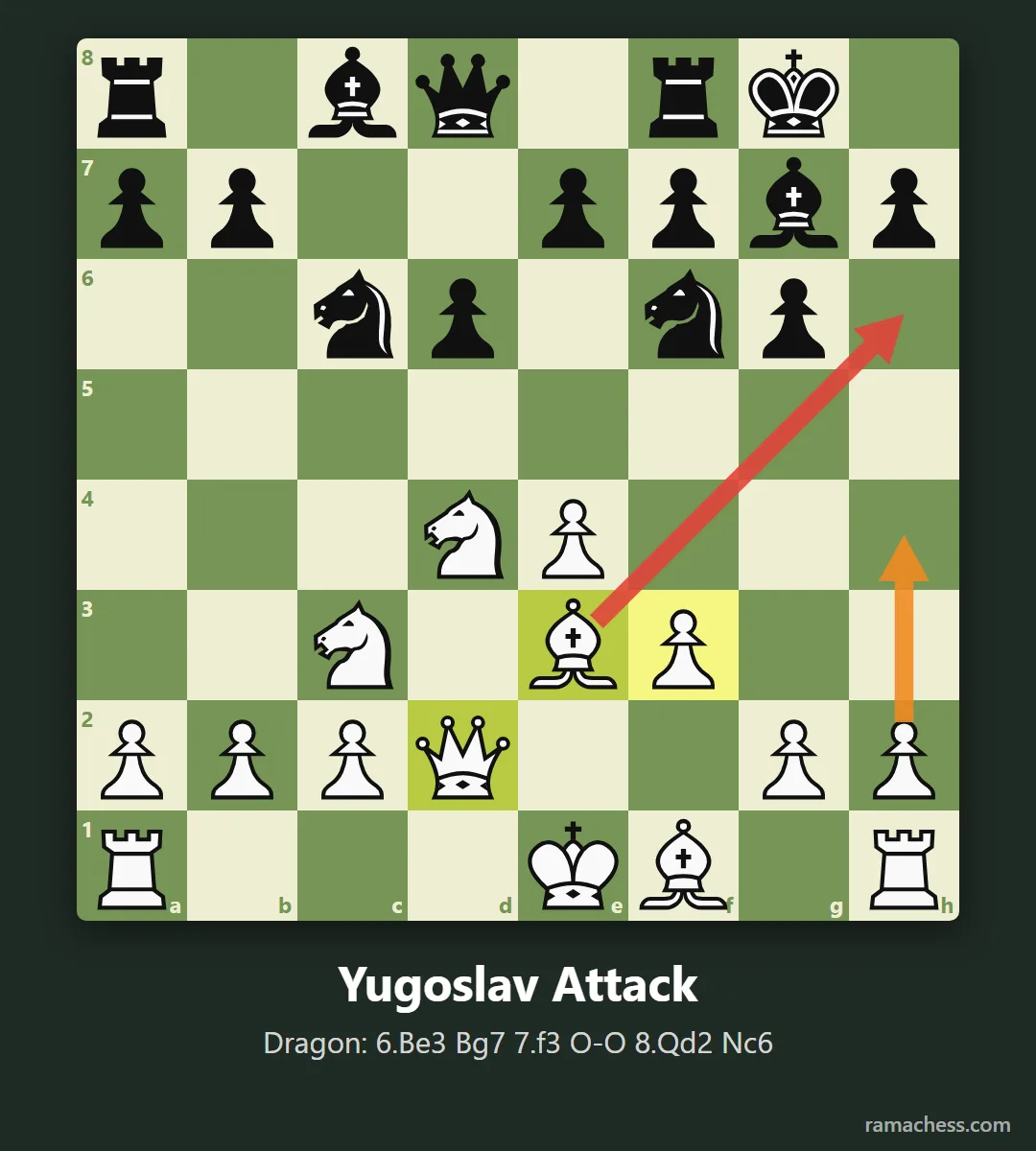
Black survives these attacks by counter-attacking fast on the queenside, usually down the half-open c-file. In the Sicilian, speed matters more than material.
Typical plans in the Sicilian
Black's plans
- Use the c-file. A rook on c8 and a queen on c7 put pressure on c2 and the knight on c3.
- The exchange sacrifice ...Rxc3. A classic Sicilian idea: Black gives a rook for the c3-knight to break White's pawns and take control of e4.
- Queenside pawn storm. With ...a6 and ...b5-b4, Black kicks the c3-knight and opens lines, especially when White has castled queenside.
- The ...d5 break. When Black can play ...d5 safely, the position usually becomes equal or better for Black.
White's plans
- Kingside attack. Pawns go forward with f4, g4 or h4, often after castling queenside. Many Sicilian games become a race between the two attacks.
- Control d5. In lines with ...e5 (the Najdorf with ...e5, the Sveshnikov), White fights to put a knight on d5.
- Sacrifices on e6, d5 or b5. Because Black's king often stays in the centre a while, White's pieces sometimes break through with a piece sacrifice.
How to learn the Sicilian
- Pick one main system after 2.Nf3: for example the Najdorf, the Dragon, the Taimanov or the Kan. Do not mix them at first.
- Prepare the anti-Sicilians. At club level you will meet 2.c3, 2.Nc3, 3.Bb5 and the Smith-Morra very often. One simple answer to each is enough.
- Study model games in your line, not only the moves. Seeing the plans in action teaches more than a list of variations.
- Play it a lot. Use the Rama Chess bots and check every game in the analysis board.
- Sharpen your tactics. Sicilian games are full of sacrifices. Do the daily puzzle and read our tactics guide.
Still choosing a Black repertoire? Compare the Sicilian with other options in the best chess openings for Black.
See all our chess opening guides.
Frequently asked questions
Is the Sicilian Defense good?
Yes. It is the most popular answer to 1.e4 among strong players and has been used by many world champions. It gives Black an unbalanced position with real winning chances, which is why it is so popular.
Is the Sicilian Defense good for beginners?
It can be, but it is not the easiest. The main lines are long and sharp, and White has many sidelines. Beginners often do better with 1...e5 or the Caro-Kann first, and switch to the Sicilian when their tactics are stronger. If you want to start with it, the Kan or Taimanov are more about ideas than memory.
What is the best line of the Sicilian?
There is no single best line. The Najdorf (5...a6) is the most famous and was the choice of Fischer and Kasparov. The Sveshnikov, Dragon, Taimanov, Kan and Scheveningen are all fully sound. Choose the one whose plans you enjoy.
What is the best way for White to play against the Sicilian?
The Open Sicilian (2.Nf3 and 3.d4) is the most ambitious. If you do not want to learn a lot of theory, the Alapin (2.c3), the Rossolimo (2...Nc6 3.Bb5) or the Moscow (2...d6 3.Bb5+) are popular and solid.
What is the Open Sicilian?
The Open Sicilian is the main line where White plays Nf3 and d4, and after ...cxd4 recaptures with the knight, for example 1.e4 c5 2.Nf3 d6 3.d4 cxd4 4.Nxd4. It opens the position and leads to the Najdorf, Dragon, Scheveningen and other main variations.
What is an anti-Sicilian?
An anti-Sicilian is any White system that avoids the Open Sicilian, such as the Alapin (2.c3), the Closed Sicilian (2.Nc3 and g3), the Grand Prix Attack (f4), the Rossolimo (3.Bb5), the Moscow (3.Bb5+) or the Smith-Morra Gambit.
What is the Sicilian Defense French Variation?
It is 1.e4 c5 2.Nf3 e6 (ECO B40). Black plays ...e6 as in the French Defence. It usually leads to the Taimanov (4...Nc6), the Kan (4...a6) or the Four Knights (4...Nf6 5.Nc3 Nc6).
What is a Sicilian attack in chess?
An aggressive White system against the Sicilian, usually with queenside castling and a kingside pawn storm: the Yugoslav Attack against the Dragon, the English Attack against the Najdorf, the Richter-Rauzer, the Sozin, the Keres Attack, and the anti-Sicilian Grand Prix Attack.
Why is it called the Sicilian Defense?
The name points to Sicily, the Italian island. The earliest known notes on 1...c5 come from Italian players of the late 16th and early 17th centuries, Giulio Polerio and Gioachino Greco. In 1813 the English writer Jacob Sarratt fixed the English name "Sicilian Defence", translating the Italian phrase for "the Sicilian game".
Keep learning on Rama Chess
Watch on YouTube
Prefer video? Our channels show real games move by move, with clear explanations.