Scandinavian and Alekhine's Defense: Moves, Plans and Traps
Two bold answers to 1.e4. In the Scandinavian (1.e4 d5) Black attacks the e4 pawn at once. In Alekhine's Defense (1.e4 Nf6) Black invites White's pawns forward and then attacks them. This guide covers both, with the main lines, ECO codes, typical traps and the lines you can train on Rama Chess.

The Scandinavian Defense (1.e4 d5)
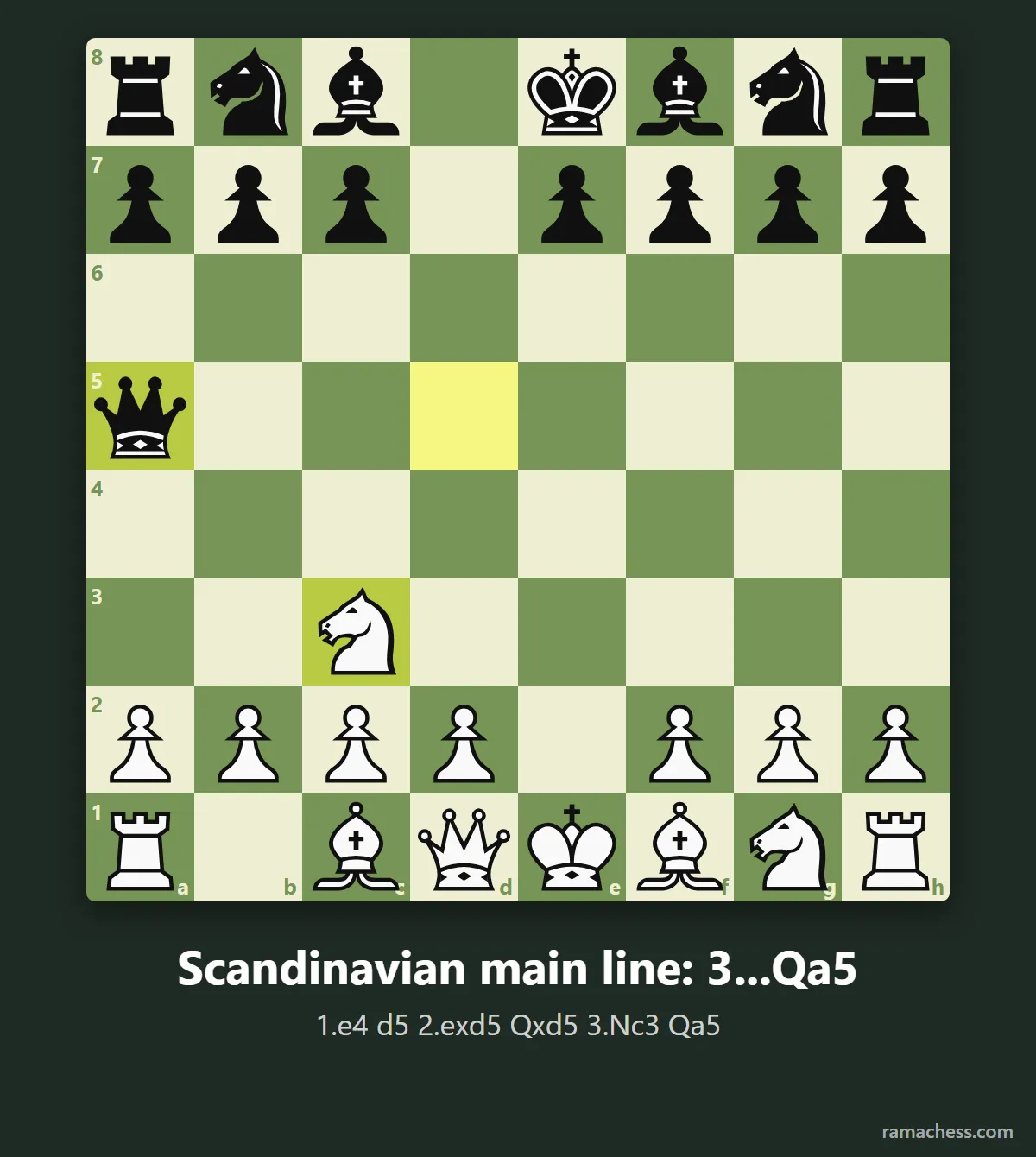
The Scandinavian, also called the Center Counter, starts with 1.e4 d5. Black hits the e4 pawn on move one. After 2.exd5 Qxd5 Black's queen comes out early, and White gains a tempo with 3.Nc3. The queen then moves again, usually to a5, d6 or d8.
Moving the queen early breaks an opening rule, but the Scandinavian is still sound. Black gets a simple position without a weak pawn, quick development with ...Nf6, ...Bf5 or ...Bg4, ...c6 and ...e6, and a pawn structure like a Caro-Kann. It is also easy to learn, because White cannot easily avoid it after 1.e4.
It is one of the oldest recorded openings: it appears in a Catalan poem, Scachs d'amor, written around 1475. Its ECO code is B01.
Alekhine's Defense (1.e4 Nf6)
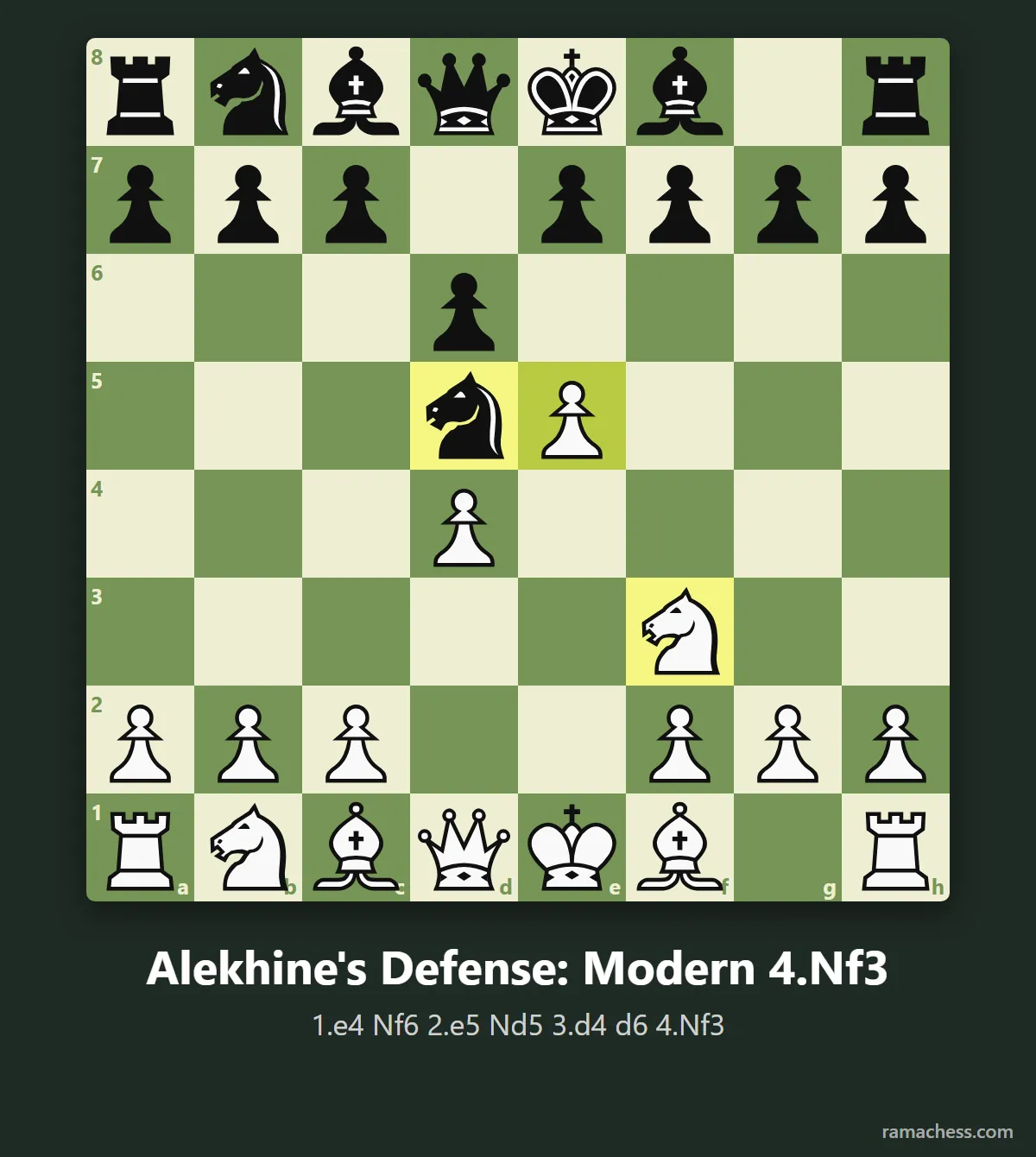
Alekhine's Defense starts with 1.e4 Nf6. The knight attacks e4, and White usually pushes it: 2.e5 Nd5. White can keep chasing the knight with c4 and d4 and build a big pawn centre. That is exactly what Black wants: a big centre can also be a big target. Black attacks it with ...d6, ...Nc6, ...Bg4 or ...g6 and ...Bg7.
The opening is named after Alexander Alekhine, who introduced it at the Budapest tournament in 1921. Its ECO codes are B02 to B05. Most of the lines in this part of our trainer are Alekhine lines, mainly the Modern Variation with 4.Nf3.
Main ideas for both sides
In the Scandinavian
- Black: develop fast (...Nf6, ...Bf5 or ...Bg4, ...c6, ...e6), keep the queen safe, and aim for a solid Caro-Kann-like structure.
- White: gain time by attacking the queen (Nc3, Bd2, Nc4 or Nb5 ideas), take space with d4, and play against Black's bishops with h3 and g4 when they come out early.
In Alekhine's Defense
- Black: let White's pawns come forward, then hit them with ...d6, ...dxe5 or ...Bg4 and ...Nc6. The knights often go to b6 and d7.
- White: keep the space advantage without letting the centre become a target. The calm Modern 4.Nf3 is the most popular way.
Main variations and ECO codes
Each move order below is checked move by move.
| Variation | ECO | Moves | Idea |
|---|---|---|---|
| Scandinavian 3...Qa5 | B01 | 1.e4 d5 2.exd5 Qxd5 3.Nc3 Qa5 | the main line today |
| Scandinavian 3...Qd6 | B01 | 1.e4 d5 2.exd5 Qxd5 3.Nc3 Qd6 | the queen guards the centre and kingside |
| Scandinavian 3...Qd8 | B01 | 1.e4 d5 2.exd5 Qxd5 3.Nc3 Qd8 | the old, quiet retreat |
| Modern Scandinavian | B01 | 1.e4 d5 2.exd5 Nf6 | Black takes back on d5 with the knight |
| Alekhine: Modern | B04-B05 | 1.e4 Nf6 2.e5 Nd5 3.d4 d6 4.Nf3 | the most common line |
| Alekhine: Four Pawns Attack | B03 | 1.e4 Nf6 2.e5 Nd5 3.d4 d6 4.c4 Nb6 5.f4 | White builds a huge centre |
| Alekhine: Exchange | B03 | 1.e4 Nf6 2.e5 Nd5 3.d4 d6 4.c4 Nb6 5.exd6 | White keeps a smaller space edge |
In the Scandinavian main line, a typical continuation is 1.e4 d5 2.exd5 Qxd5 3.Nc3 Qa5 4.d4 c6 5.Nf3 Nf6 6.Bc4 Bf5 7.Bd2 e6. In the Four Pawns Attack against Alekhine's Defense, the main line goes 1.e4 Nf6 2.e5 Nd5 3.d4 d6 4.c4 Nb6 5.f4 dxe5 6.fxe5 Nc6, with Black attacking the d4 pawn at once.
Traps and typical tactics
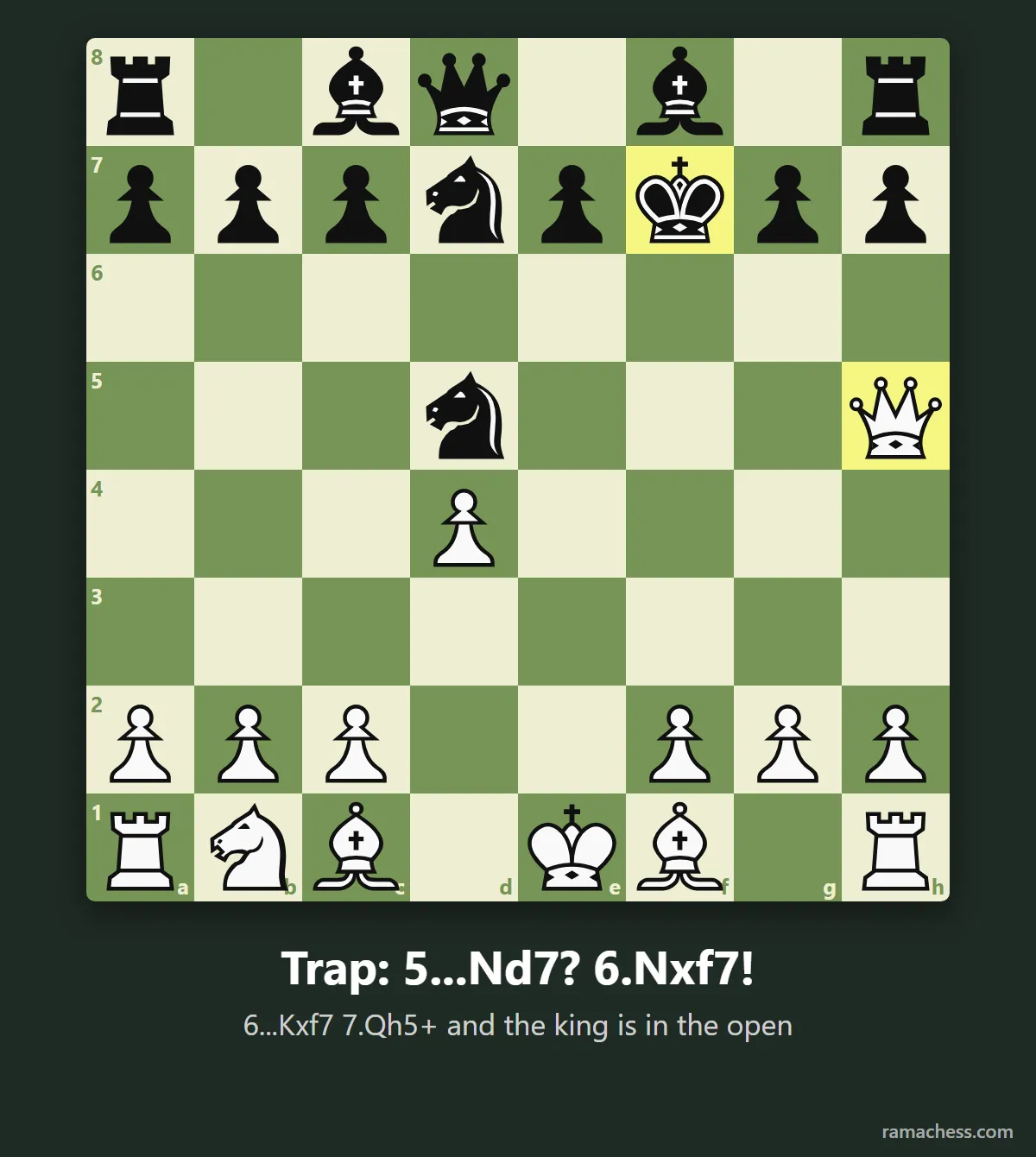
Alekhine's Defense: the f7 sacrifice. In the Modern Variation, after 1.e4 Nf6 2.e5 Nd5 3.d4 d6 4.Nf3 dxe5 5.Nxe5, the natural-looking 5...Nd7? allows 6.Nxf7!. After 6...Kxf7 7.Qh5+ the black king usually has to step forward to e6, because ...g6 or ...Kg8 run into Qxd5. Stockfish rates 6.Nxf7 as clearly better for White. The usual moves here are 5...c6 or 5...g6.
Scandinavian: the bishop chase. In the 3...Qa5 line, an early ...Bg4 can get Black in trouble. After 1.e4 d5 2.exd5 Qxd5 3.Nc3 Qa5 4.d4 Nf6 5.Nf3 Bg4 6.h3 Bh5 7.g4 Bg6 8.Ne5, White threatens h4-h5 against the bishop and Nc4 against the queen. Stockfish gives White a clear advantage here. Many Scandinavian players prefer ...c6 first, so the queen has a retreat on c7 or d8.
Other ideas to know: in the Scandinavian, watch for Bd2 and Nd5 or Nb5 discovering attacks on a queen on a5; in the Alekhine, watch for White's c5 trapping a knight on b6 or d5 when it has no squares.
Who plays them?
Scandinavian: Viswanathan Anand played it against Garry Kasparov in game 14 of their 1995 world championship match, the first time it appeared in such a match. Magnus Carlsen has used it too, including a win against Fabiano Caruana at the 2014 Chess Olympiad. Bent Larsen beat Anatoly Karpov with it at Montreal 1979.
Alekhine's Defense: Bobby Fischer played it twice against Boris Spassky in their 1972 world championship match. Viktor Korchnoi had it in his repertoire, and Magnus Carlsen used it to beat Veselin Topalov at Linares 2008.
See how engines play these lines: engine games in the Scandinavian. If you want a solid answer to 1.e4 with more theory behind it, look at the Caro-Kann Defense.
Practice the Scandinavian and Alekhine Defense in the Rama Chess trainer
Reading a guide is the first step. To make the moves stick, practise them. Our opening trainer has 8 Scandinavian and Alekhine Defense lines. Each one is checked with Stockfish. You watch the moves with arrows, replay them from memory, then take a test. The full set of lines is part of Rama Chess Premium.
Most lines here are Alekhine lines with the Modern 4.Nf3 (B04-B05). There is also a Scandinavian line with 3.Nc3 Qa5 (B01).
See all our chess opening guides.
Scandinavian and Alekhine Defense FAQ
What are the moves of the Scandinavian Defense?
It starts with 1.e4 d5. The main line is 1.e4 d5 2.exd5 Qxd5 3.Nc3 Qa5. Another option is 1.e4 d5 2.exd5 Nf6, the Modern Scandinavian.
What are the moves of Alekhine's Defense?
It starts with 1.e4 Nf6. After 1.e4 Nf6 2.e5 Nd5 3.d4 d6 4.Nf3 you reach the Modern Variation, the most common line.
Is the Scandinavian Defense good?
Yes. It is sound, simple and has been used at world championship level. Black loses a little time with the queen, but gets a solid position with no weaknesses.
Is Alekhine's Defense good?
It is a sound but provocative opening. Black lets White build a big centre and then attacks it. It is less popular than the Sicilian or the French, but strong players including Fischer and Carlsen have played it.
Which ECO codes cover these openings?
The Scandinavian is B01. Alekhine's Defense is B02 to B05: B03 covers 3.d4 lines like the Four Pawns Attack and the Exchange, and B04-B05 the Modern Variation.
Are they good for beginners?
The Scandinavian is a good choice for beginners: the ideas are simple and you get it in almost every 1.e4 game. Alekhine's Defense needs more understanding of how to attack a pawn centre.
Watch on YouTube
Prefer video? Our channels show real games move by move, with clear explanations.
Ready to practise?
You know the ideas. Now train the moves until you play them without thinking.