Pirc and Modern Defense: Moves, Plans and Main Lines
The Pirc and the Modern are "hypermodern" defences. Black lets White build a big pawn centre with e4 and d4, puts the bishop on g7, and then attacks that centre from the side. This guide explains both openings, White's three main systems, the ECO codes and the typical tactics.

What is the Pirc Defense?
The Pirc starts with 1.e4 d6 2.d4 Nf6 3.Nc3 g6. Black puts the bishop on g7, castles short and only later hits the centre with ...c5, ...e5 or ...c6 and ...b5. It looks like a King's Indian Defense, but White has not played c4.
The idea is hypermodern: instead of holding the centre with pawns, Black controls it from a distance with pieces, and waits for White to over-extend. The risk is that White's centre gets too strong and Black is pushed back.
It is named after the Slovenian grandmaster Vasja Pirc, who played it often from the late 1940s. In Russia it is often called the Ufimtsev Defense. The ECO codes are B07 to B09.
The Modern Defense (1.e4 g6)
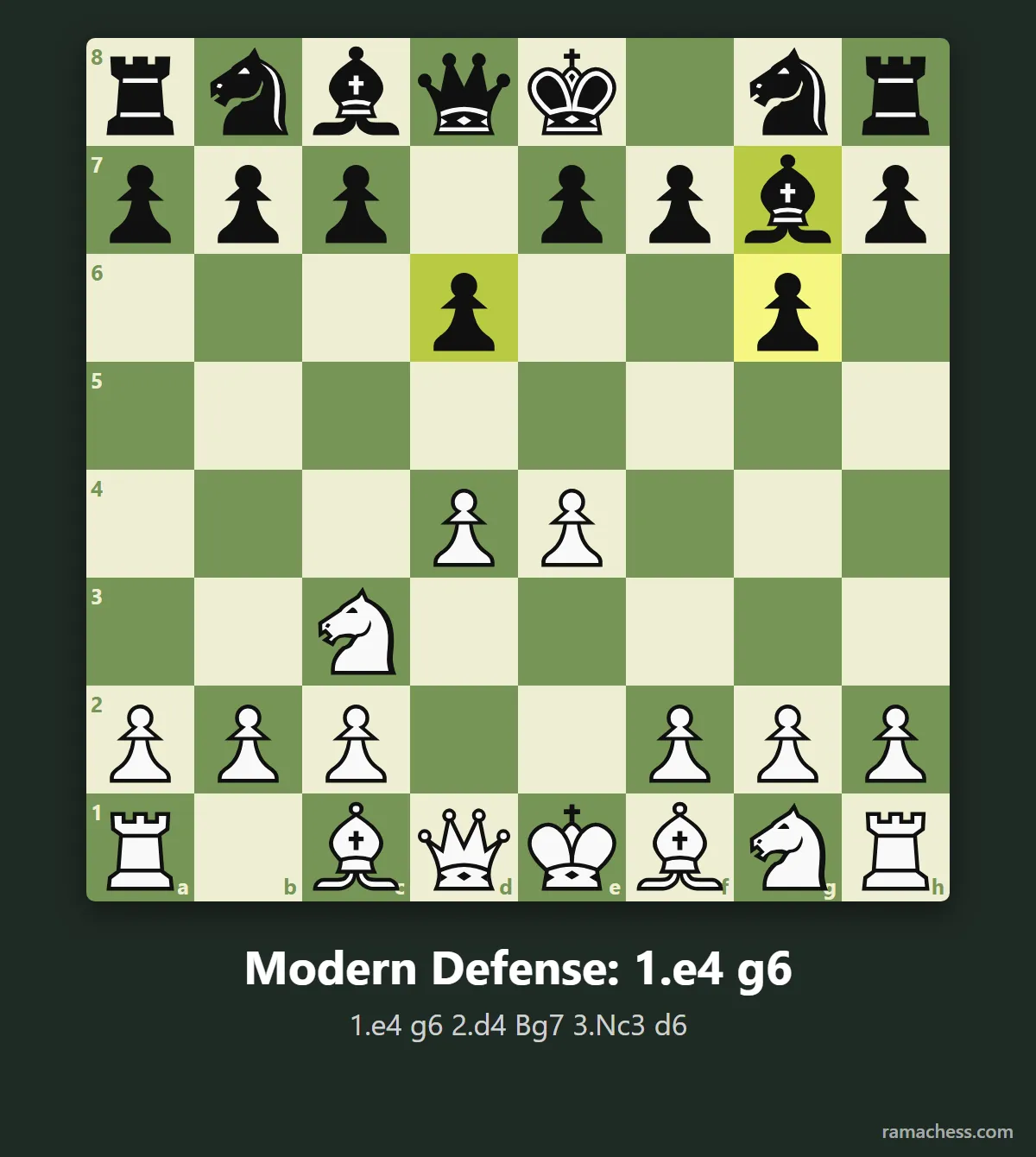
The Modern Defense, also called the Robatsch, starts with 1.e4 g6. It is a close cousin of the Pirc. The difference is that Black delays ...Nf6. That gives Black extra choices, such as ...c6 and ...d5, or ...a6 and ...b5 on the queenside. It also gives White more freedom, for example to play c4 and get a King's Indian with an extra option.
The Modern Defense has the ECO code B06. The two openings often transpose into each other.
The main ideas for both sides
Black's plans
- The g7 bishop. It presses on d4 and the long diagonal. Black keeps it as long as possible.
- Breaks against the centre. ...c5 or ...e5 hits White's d4 pawn. In some lines Black plays ...c6, ...b5 and ...Nbd7.
- Counter-attack. When White pushes e5, Black hits the pawn with ...dxe5, ...Nd5 or ...Ng4.
White's plans
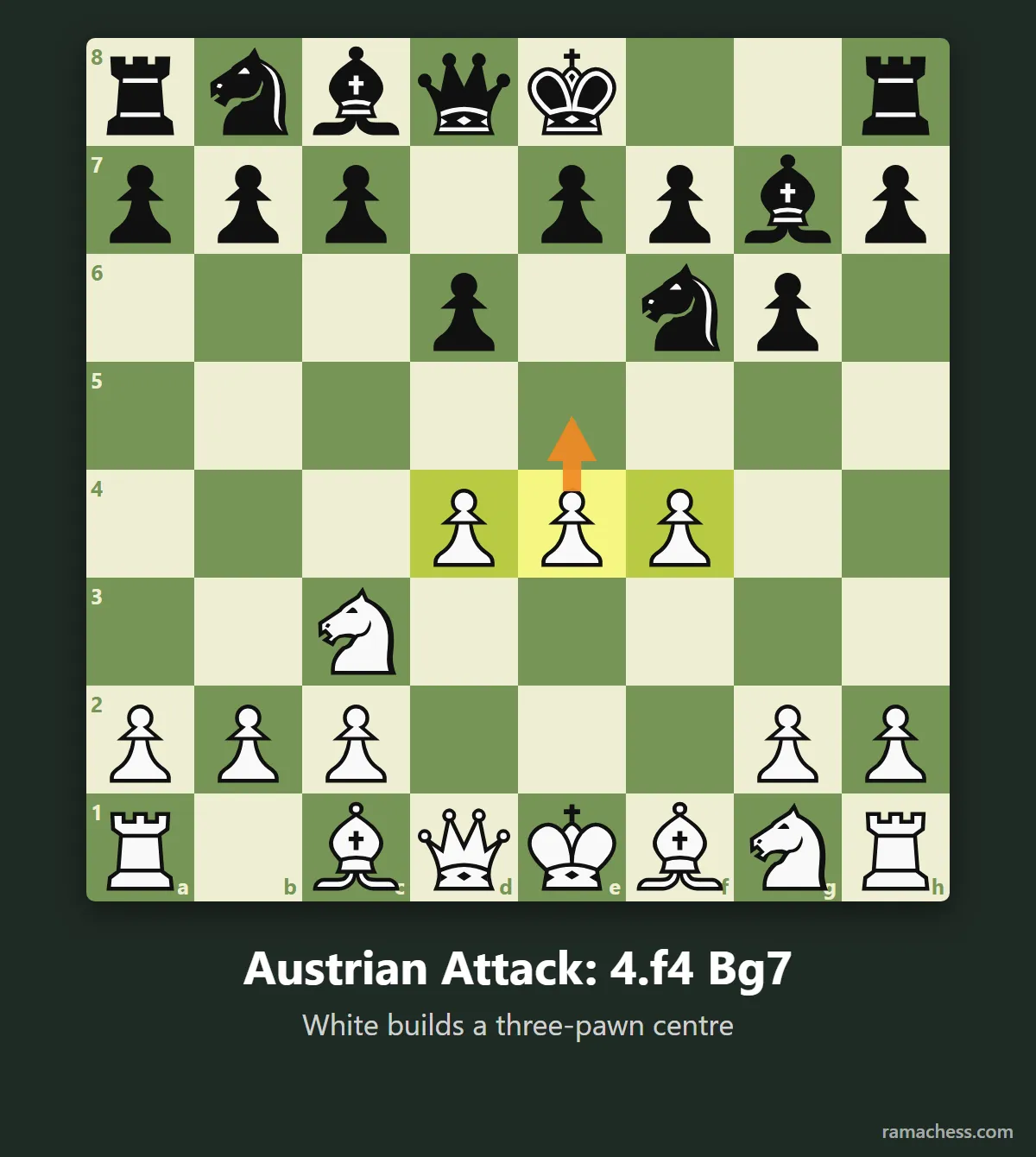
- Big centre. In the Austrian Attack White plays f4 and e5 to push the f6 knight away.
- Kingside attack. With Be3, Qd2, Bh6 and h4-h5 (the "150 Attack"), White trades the g7 bishop and attacks the king.
- Calm space. In the Classical, White develops normally and keeps a small but lasting space advantage.
Main variations of the Pirc
White has three main systems against the Pirc. Each move order below is checked move by move.
| Variation | ECO | Moves | Idea |
|---|---|---|---|
| Austrian Attack | B09 | 1.e4 d6 2.d4 Nf6 3.Nc3 g6 4.f4 | the most aggressive system |
| Classical (Two Knights) | B08 | 1.e4 d6 2.d4 Nf6 3.Nc3 g6 4.Nf3 Bg7 5.Be2 O-O 6.O-O | calm and solid development |
| 150 Attack | B07 | 1.e4 d6 2.d4 Nf6 3.Nc3 g6 4.Be3 | Be3, Qd2, Bh6 and a kingside attack |
| Modern Defense | B06 | 1.e4 g6 2.d4 Bg7 3.Nc3 d6 | Black delays ...Nf6 |
| Modern: ...a6 set-up | B06 | 1.e4 g6 2.d4 Bg7 3.Nc3 a6 | queenside play with ...b5 |
The Austrian Attack (4.f4) is the most direct. After 4...Bg7 5.Nf3 Black chooses between castling with 5...O-O and the counter-attack 5...c5.
The Classical (4.Nf3 Bg7 5.Be2 O-O 6.O-O) is a quiet system. Our trainer line continues with ...Bg4, ...Nc6 and ...e5, a typical way for Black to fight for the centre.
The 150 Attack (4.Be3 with Qd2) got its name because it is easy to play for a club player rated about 150 on the old English (ECF) scale. It is still dangerous at every level.
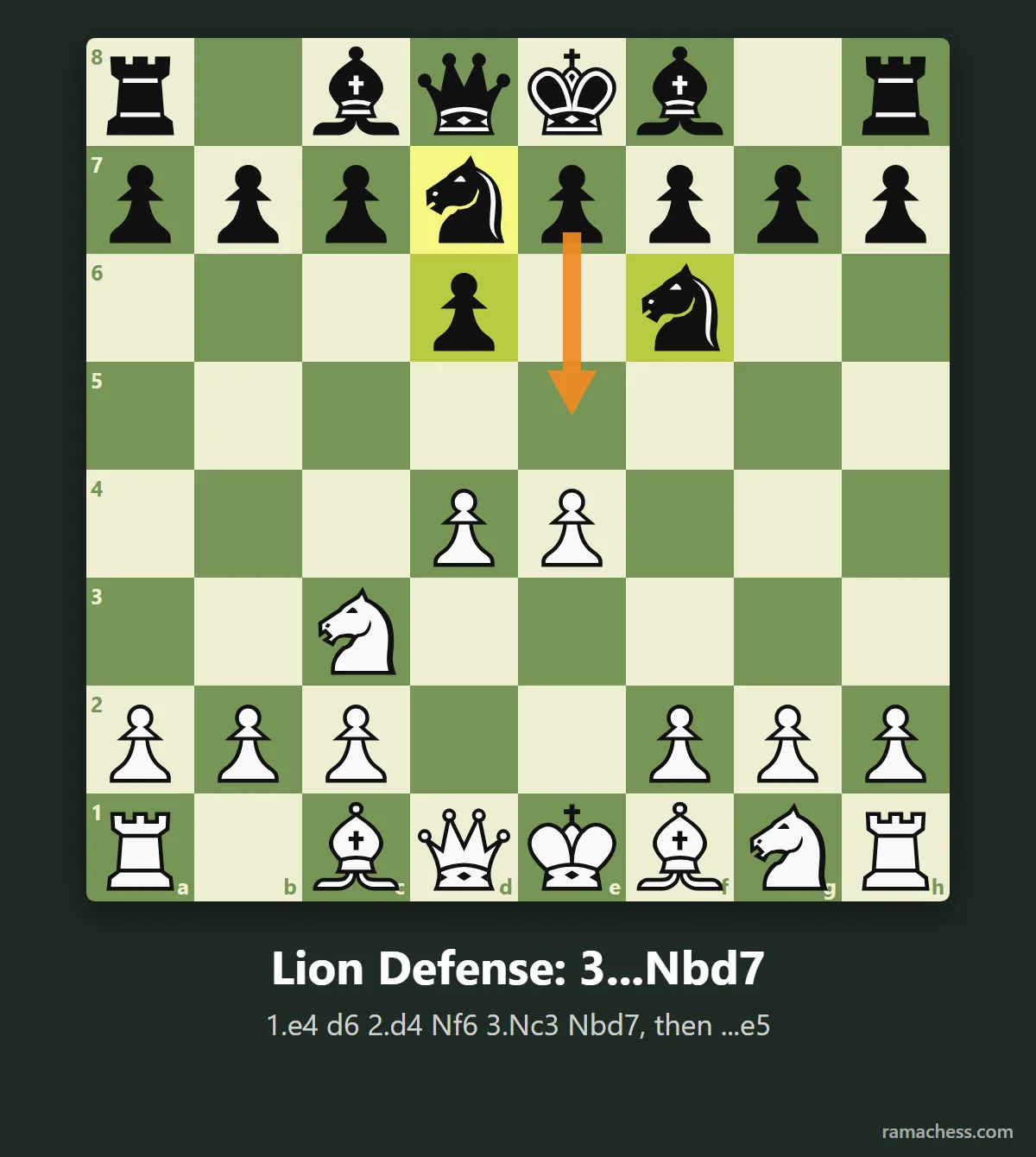
The Lion Defense (1.e4 d6 2.d4 Nf6 3.Nc3 Nbd7)
The Lion Defense is a cousin of the Pirc: 1.e4 d6 2.d4 Nf6 3.Nc3 Nbd7, followed by ...e5. Instead of the fianchetto with ...g6, Black aims for a Philidor-style pawn structure with pawns on d6 and e5 and the knight on d7. Opening databases (for example the Lichess opening list) classify it as ECO B07; when White plays Nf3 and Black has ...e5 it is also called the Lion Variation of the Philidor Defence (C41).
Black's plan is simple: ...e5, ...Be7, ...O-O and ...c6, keeping the centre closed and solid. White's sharpest answer is the "Anti-Philidor" 4.f4, attacking at once; after 4...e5 5.Nf3 the game is tense. A quieter answer is 4.Nf3 e5 5.Bc4, aiming at f7.
A related line is the Lion's Jaw, 1.e4 d6 2.d4 Nf6 3.f3, where White builds a solid centre first.
Is the Lion Defense good? It is playable but a little passive. Stockfish 18 (depth 24) rates White about +0.8 after 3...Nbd7, very similar to the main Pirc (about +0.8 after 3...g6). Its strength is that the plans are easy to learn and the structure is very hard to break for club players.
Typical tactics
- e5 push. In the Austrian Attack, e4-e5 kicks the f6 knight. If Black is not ready, the knight has no good square.
- Bh6 and h4-h5. When White castles long, the plan is to trade the g7 bishop and open the h-file.
- ...c5 and ...Qa5. Black's queen on a5 often pins the c3 knight and hits White's queenside after White castles long.
- Breaking with ...e5. If White's d4 pawn is not well defended, ...e5 or ...c5 can win it or open the long diagonal for the g7 bishop.
Because Black gives White so much space, a single slow move can be fatal for either side. Count every pawn push in the centre.
Who plays the Pirc and the Modern?
Bobby Fischer played the Pirc once in his 1972 world championship match against Boris Spassky (game 17, a draw). The most famous Pirc game of all is Kasparov against Topalov at Wijk aan Zee 1999, often called "Kasparov's Immortal", which Kasparov won with White. Zurab Azmaiparashvili beat Anatoly Karpov with the Pirc in 1983. See how engines play these set-ups in our engine games in the Pirc and engine games in the Modern Defense.
Is it right for you? Play the Pirc or Modern if you like flexible positions and counter-attacks, and are not afraid of a big centre. If you prefer a solid structure, try the Caro-Kann Defense; if you like the g7 bishop against 1.d4, look at the King's Indian Defense.
Practice the Pirc and Modern Defense in the Rama Chess trainer
Reading a guide is the first step. To make the moves stick, practise them. Our opening trainer has 2 Pirc and Modern Defense lines. Each one is checked with Stockfish. You watch the moves with arrows, replay them from memory, then take a test. The full set of lines is part of Rama Chess Premium.
Our trainer has two lines here: a Modern Defense line with 1.e4 g6 2.d4 Bg7 3.Nc3 a6 4.f4 (B06) and a Pirc Classical line with 4.Nf3 Bg7 5.Be2 O-O 6.O-O (B08).
See all our chess opening guides.
Pirc and Modern Defense FAQ
What are the moves of the Pirc Defense?
The Pirc starts with 1.e4 d6 2.d4 Nf6 3.Nc3 g6. Black then plays ...Bg7 and castles short.
What is the difference between the Pirc and the Modern Defense?
In the Pirc Black plays ...Nf6 early. In the Modern (1.e4 g6) Black delays ...Nf6 and keeps more options, such as ...c6 and ...d5 or ...a6 and ...b5.
What is the best line against the Pirc?
The Austrian Attack (4.f4) is the most aggressive, the 150 Attack (4.Be3 and Qd2) is popular and easy to play, and the Classical (4.Nf3 and Be2) is the safest.
Is the Pirc Defense good for beginners?
It can be risky for beginners, because Black gives White a lot of space. It is better to learn it after you understand how to attack a pawn centre.
Who is the Pirc named after?
Vasja Pirc, a Slovenian grandmaster who played it often from the late 1940s.
Which ECO codes cover the Pirc and the Modern?
The Modern Defense is B06. The Pirc is B07 to B09: B08 is the Classical 4.Nf3 and B09 is the Austrian Attack 4.f4.
What is the Lion Defense in chess?
The Lion Defense is 1.e4 d6 2.d4 Nf6 3.Nc3 Nbd7 followed by ...e5. Black builds a solid Philidor-style centre with pawns on d6 and e5 instead of fianchettoing the bishop as in the Pirc.
Watch on YouTube
Prefer video? Our channels show real games move by move, with clear explanations.
Ready to practise?
You know the ideas. Now train the moves until you play them without thinking.