Sicilian Najdorf: Moves, Plans, Main Lines and Traps
The Najdorf is the sharpest and most famous line of the Sicilian Defense. Black plays the small move 5...a6 and keeps every option open. This guide shows the moves, the plans for both sides, the main variations with ECO codes, a real trap, and 178 lines you can train on Rama Chess.

What is the Sicilian Najdorf?
The Najdorf starts with 1.e4 c5 2.Nf3 d6 3.d4 cxd4 4.Nxd4 Nf6 5.Nc3 a6. It is part of the Open Sicilian, where White plays d4 and trades a centre pawn for Black's c-pawn. Black gets a half-open c-file and two centre pawns against one. White gets more space and faster development.
The key move is 5...a6. It looks slow, but it does three useful jobs. It keeps White's pieces off b5. It prepares ...b5 to gain space on the queenside. And it waits: Black has not yet decided between ...e5 and ...e6, so White must show a plan first.
The line is named after Miguel Najdorf, a Polish-Argentine grandmaster who played it in the 1940s and 1950s. It has the ECO codes B90 to B99.
The main ideas for both sides
Black's plans
- ...e5 or ...e6. With ...e5 Black kicks the d4 knight and takes space, but leaves a hole on d5. With ...e6 Black keeps a small, flexible centre (the Scheveningen set-up).
- Queenside play. ...b5, ...Bb7, ...Nbd7 and a rook on c8 point everything at White's queenside, often at the king when White castles long.
- The ...d5 break. When Black can play ...d5 safely, the d6 weakness is gone and Black is usually fine.
- The exchange sacrifice ...Rxc3. A classic Sicilian idea: Black gives a rook for the c3 knight to smash White's pawns.
White's plans
- Attack the king. In the English Attack and the 6.Bg5 lines White castles long and throws the g- and h-pawns forward.
- Control d5. After ...e5, the d5 square is White's best square. A knight on d5 is a dream piece.
- Sacrifices on e6, d5 and b5. If Black's king stays in the centre too long, White has many pieces aimed at it.
Main variations of the Najdorf
White has many 6th moves. These are the ones you will meet most. Each move order below is checked move by move.
| Variation | ECO | Moves | Idea |
|---|---|---|---|
| English Attack | B90 | 1.e4 c5 2.Nf3 d6 3.d4 cxd4 4.Nxd4 Nf6 5.Nc3 a6 6.Be3 | f3, Qd2, O-O-O and a g-pawn storm |
| Adams Attack | B90 | 1.e4 c5 2.Nf3 d6 3.d4 cxd4 4.Nxd4 Nf6 5.Nc3 a6 6.h3 | g4 at once, before Black is ready |
| Fianchetto (Zagreb) | B91 | 1.e4 c5 2.Nf3 d6 3.d4 cxd4 4.Nxd4 Nf6 5.Nc3 a6 6.g3 | quiet: the bishop watches d5 from g2 |
| Opocensky (Classical) | B92 | 1.e4 c5 2.Nf3 d6 3.d4 cxd4 4.Nxd4 Nf6 5.Nc3 a6 6.Be2 | solid; often meets 6...e5 |
| Amsterdam | B93 | 1.e4 c5 2.Nf3 d6 3.d4 cxd4 4.Nxd4 Nf6 5.Nc3 a6 6.f4 | pressure on e5 and a kingside push |
| Main line 6.Bg5 | B94-B99 | 1.e4 c5 2.Nf3 d6 3.d4 cxd4 4.Nxd4 Nf6 5.Nc3 a6 6.Bg5 e6 7.f4 | the oldest and sharpest main line |
| Poisoned Pawn | B97 | 1.e4 c5 2.Nf3 d6 3.d4 cxd4 4.Nxd4 Nf6 5.Nc3 a6 6.Bg5 e6 7.f4 Qb6 8.Qd2 Qxb2 | Black grabs b2 and survives an attack |
| Fischer-Sozin Attack | B86 | 1.e4 c5 2.Nf3 d6 3.d4 cxd4 4.Nxd4 Nf6 5.Nc3 a6 6.Bc4 | the bishop aims at e6 and f7 |
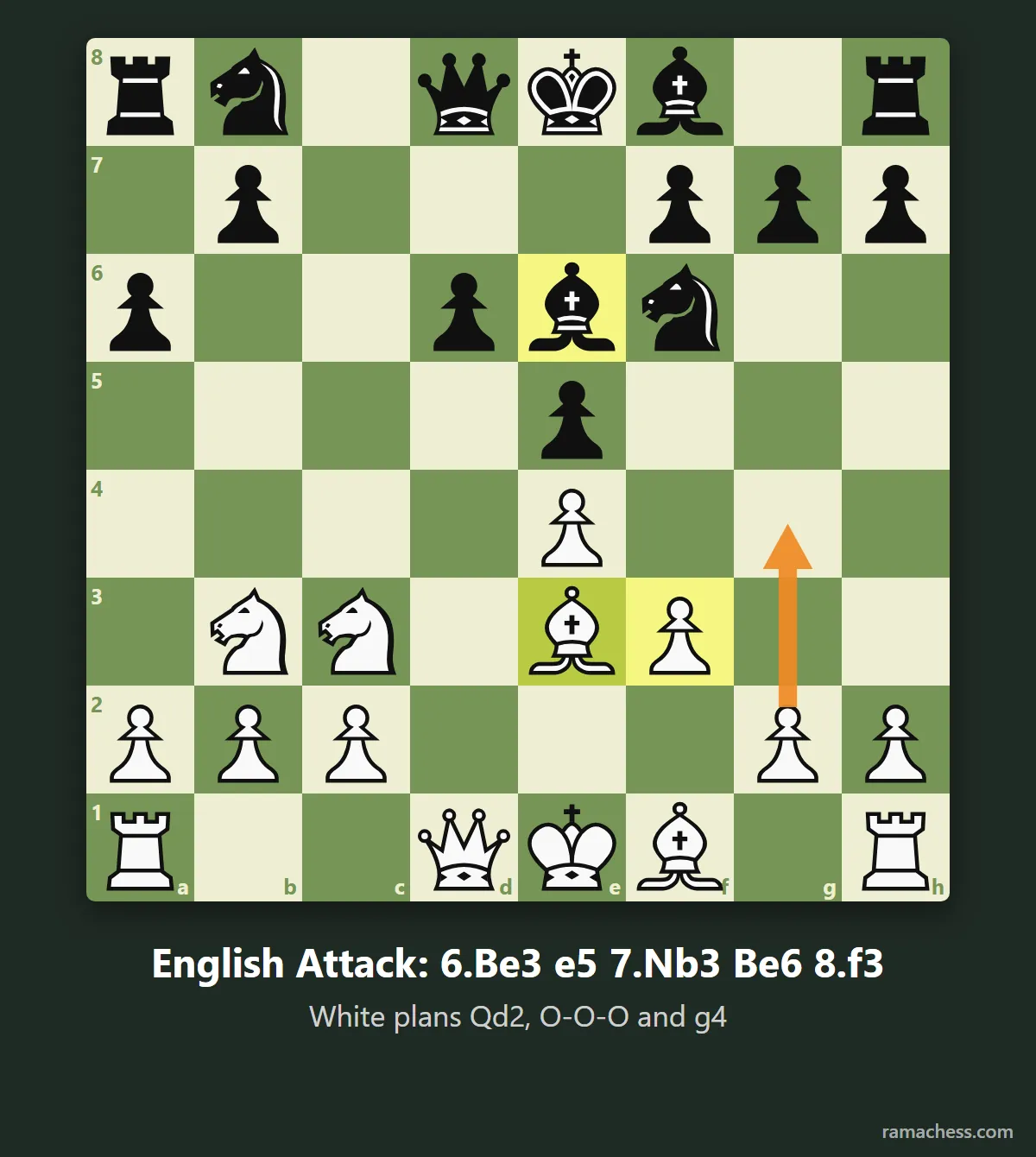
The English Attack (6.Be3) is the most popular modern try. White plays f3, Qd2, O-O-O and g4. Black answers with ...e5 or ...e6, then ...b5 and a fast queenside attack. Both kings are often under fire.
6.Be3 Ng4 is a sharp answer: the knight hits the bishop at once. After 6.Be3 Ng4 7.Bg5 h6 8.Bh4 g5 9.Bg3 Bg7 Black has gained space on the kingside with tempo. This is one of the free lines in our trainer.
6.Be2 is the calm, classical choice. After 6.Be2 e5 7.Nb3 White castles short and fights slowly for d5.
The 6.Bg5 main line and the Poisoned Pawn
The oldest main line is 1.e4 c5 2.Nf3 d6 3.d4 cxd4 4.Nxd4 Nf6 5.Nc3 a6 6.Bg5 e6 7.f4. White pins the knight and gets ready for e5. Black has several replies: 7...Be7 (the old main line, B98-B99), 7...b5 (the Polugaevsky) and the most famous of all, 7...Qb6.
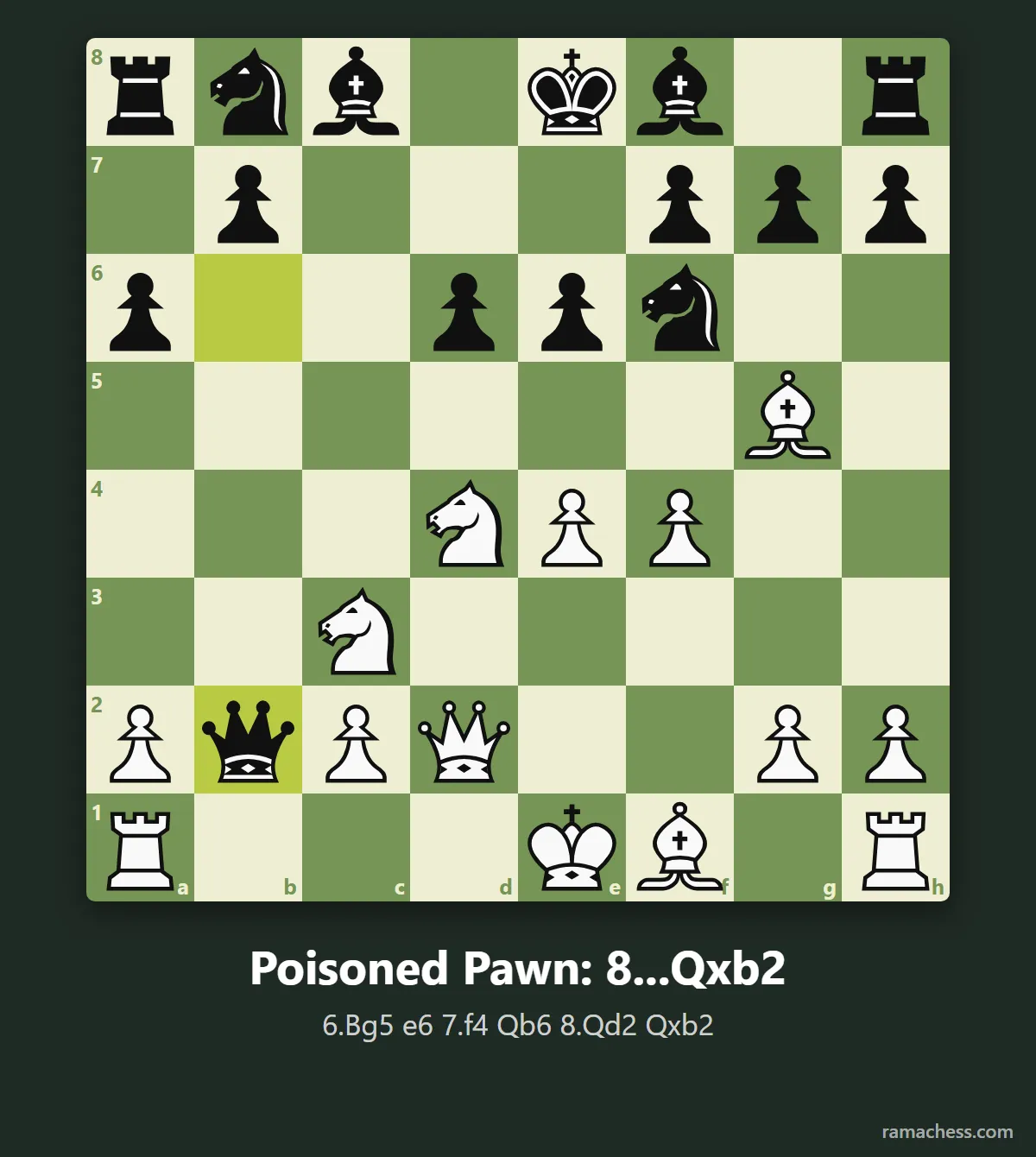
After 7...Qb6 8.Qd2 Qxb2 Black takes the b2 pawn with the queen. This is the Poisoned Pawn (B97). The queen can get trapped, and White gets a big lead in development, but theory says Black can survive with exact play. Bobby Fischer made it his own weapon. It was also the line in which Boris Spassky beat him in game 11 of the 1972 World Championship match, Fischer's only loss in the Poisoned Pawn. Fischer still won the match.
Traps and typical tactics
The Najdorf is full of tactics. Here is one simple trap that many players fall into, checked with Stockfish:
After 1.e4 c5 2.Nf3 d6 3.d4 cxd4 4.Nxd4 Nf6 5.Nc3 a6 6.Bc4 e5 7.Nf5 Bxf5 8.exf5 the break 8...d5? looks natural, but it just loses a pawn to 9.Nxd5!. The d5 pawn is attacked by the knight, the c4 bishop and, after the trades, by the queen on the open d-file. Stockfish rates the position after 9.Nxd5 as close to two pawns better for White.
Typical tactics to know:
- Nd5 sacrifice. White puts a knight on d5; if ...exd5, the e-file opens against Black's king.
- Bxe6 or Nxe6. With the bishop on c4 or b3, the e6 point is the target.
- Trapped queen on b2. In the Poisoned Pawn, Black's queen has few squares. Rb1 and Nb3 or Na4 ideas can trap it.
- ...Rxc3. Black's exchange sacrifice ruins White's queenside pawns in front of a long-castled king.
Who plays the Najdorf?
The Najdorf is a fighting opening for players who want to win with Black. Bobby Fischer and Garry Kasparov, two of the greatest world champions, both used it as their main answer to 1.e4. In the modern game, Maxime Vachier-Lagrave is the best-known Najdorf expert at the top level. Engines like Stockfish also play it often in top engine events, which you can watch in our engine games in the Sicilian.
Is it right for you? The Najdorf asks for a lot of theory and good tactics. If you like sharp positions with attacks on both sides, it is a great choice. If you want something calmer against 1.e4, look at the Caro-Kann Defense.
Practice the Sicilian Najdorf in the Rama Chess trainer
Reading a guide is the first step. To make the moves stick, practise them. Our opening trainer has 178 Sicilian Najdorf lines. Each one is checked with Stockfish. You watch the moves with arrows, replay them from memory, then take a test. Some lines are free for everyone; the others are part of Rama Chess Premium.
We suggest you begin with 6.Be3 (B90) and 6.Be2 (B92), because you will meet them most often.
See all our chess opening guides.
Sicilian Najdorf FAQ
What are the moves of the Sicilian Najdorf?
The Najdorf starts with 1.e4 c5 2.Nf3 d6 3.d4 cxd4 4.Nxd4 Nf6 5.Nc3 a6. The move 5...a6 is what makes it the Najdorf.
Why does Black play 5...a6 in the Najdorf?
5...a6 stops White pieces from using b5, prepares ...b5 to gain space, and keeps the choice between ...e5 and ...e6 open until White shows a plan.
What is the best move for White against the Najdorf?
There is no single best move. 6.Be3 (the English Attack) and 6.Bg5 are the sharpest and most popular at top level. 6.Be2 and 6.h3 are good, simpler choices.
What is the Poisoned Pawn variation?
It is the line 1.e4 c5 2.Nf3 d6 3.d4 cxd4 4.Nxd4 Nf6 5.Nc3 a6 6.Bg5 e6 7.f4 Qb6 8.Qd2 Qxb2, where Black grabs the b2 pawn with the queen. It is very sharp, ECO B97, and was a favourite of Bobby Fischer.
Is the Sicilian Najdorf good for beginners?
It is a great opening, but it has a lot of theory and sharp tactics. Beginners can learn the ideas first and play it in casual games, but a simpler defence is often easier to start with.
Which ECO codes cover the Najdorf?
The Najdorf is B90 to B99. For example 6.g3 is B91, 6.Be2 is B92, 6.f4 is B93, and the 6.Bg5 lines are B94 to B99.
Watch on YouTube
Prefer video? Our channels show real games move by move, with clear explanations.
Ready to practise?
You know the ideas. Now train the moves until you play them without thinking.