Benoni Defense and Benko Gambit: Moves, Plans and Main Lines
After 1.d4 Nf6 2.c4 c5 3.d5 Black has two sharp, ambitious plans. The Modern Benoni (3...e6) creates an unbalanced pawn structure with play on both wings. The Benko Gambit (3...b5) gives a pawn for long-lasting pressure on the queenside. This guide explains both, with ECO codes, plans, one real trap and the lines you can train on Rama Chess.

What are the Benoni and the Benko?
Both openings start with 1.d4 Nf6 2.c4 c5. Black hits the d4 pawn at once, and White usually answers 3.d5, gaining space. Now Black chooses.
In the Modern Benoni, Black plays 3...e6 and after 4.Nc3 exd5 5.cxd5 d6 the typical structure appears: White has a central pawn majority (d5 and e4), Black has a queenside majority (c5 and b7). The game is unbalanced from move five. The Modern Benoni has the ECO codes A60 to A79. Frank Marshall introduced it in the 1920s, and Mikhail Tal made it famous in the 1950s.
In the Benko Gambit, Black plays 3...b5 and offers a pawn. It is named after the grandmaster Pal Benko, who played it and wrote a book about it in the 1970s. In Eastern Europe it is also called the Volga Gambit. It has the ECO codes A57 to A59.
The main ideas in the Modern Benoni
Black's plans
- The g7 bishop. Black fianchettoes, and the bishop on g7 is a monster on the long diagonal.
- Queenside expansion. ...a6, ...b5 and sometimes ...c4 use the queenside majority.
- Piece play. A rook on e8, a knight on e5 and active pieces make up for the slightly weak d6 pawn.
White's plans
- The e4-e5 break. White's main idea. When it works, lines open and the d-pawn can become a passed pawn.
- Stop ...b5. Moves like a4 keep Black's queenside quiet.
- Use the space. White has more room in the centre and often on the kingside too.
Main variations
These are the main lines of both openings. Each move order below is checked move by move.
| Variation | ECO | Moves | Idea |
|---|---|---|---|
| Modern Benoni | A60-A79 | 1.d4 Nf6 2.c4 c5 3.d5 e6 4.Nc3 exd5 5.cxd5 d6 | the typical Benoni pawn structure |
| Classical | A70-A79 | 1.d4 Nf6 2.c4 c5 3.d5 e6 4.Nc3 exd5 5.cxd5 d6 6.e4 g6 7.Nf3 Bg7 8.Be2 O-O 9.O-O | White develops calmly and aims for e5 |
| Taimanov Attack | A67 | 1.d4 Nf6 2.c4 c5 3.d5 e6 4.Nc3 exd5 5.cxd5 d6 6.e4 g6 7.f4 Bg7 8.Bb5+ | very dangerous for Black |
| Four Pawns | A68-A69 | 1.d4 Nf6 2.c4 c5 3.d5 e6 4.Nc3 exd5 5.cxd5 d6 6.e4 g6 7.f4 Bg7 8.Nf3 O-O | a big centre ready for e5 |
| Fianchetto | A62-A64 | 1.d4 Nf6 2.c4 c5 3.d5 e6 4.Nc3 exd5 5.cxd5 d6 6.Nf3 g6 7.g3 Bg7 8.Bg2 O-O | quiet; the g2 bishop guards e4 |
| Benko Gambit | A57 | 1.d4 Nf6 2.c4 c5 3.d5 b5 | Black offers the b-pawn |
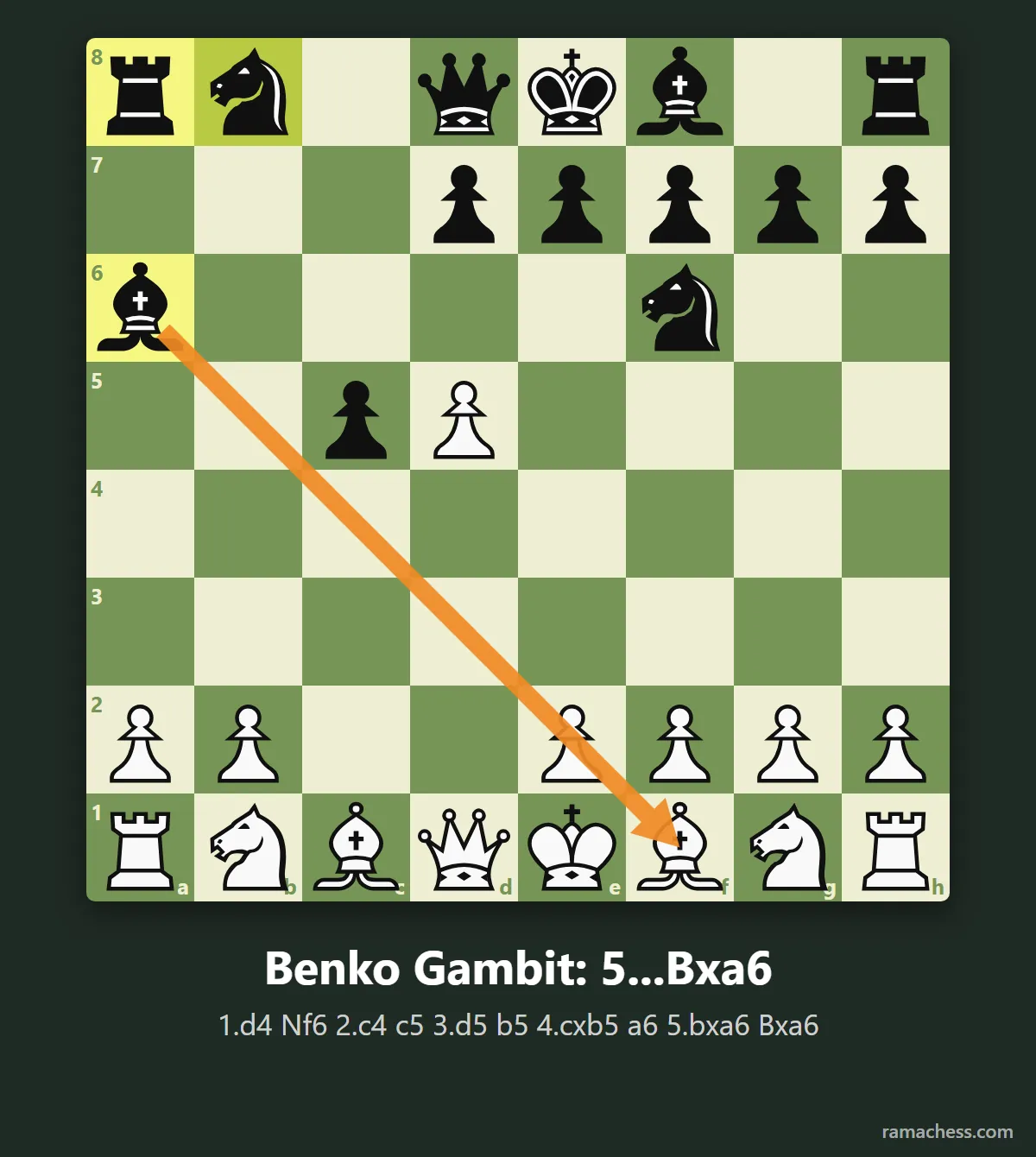
| Benko Gambit Accepted | A58-A59 | 1.d4 Nf6 2.c4 c5 3.d5 b5 4.cxb5 a6 5.bxa6 Bxa6 | open a- and b-files for Black |
The Classical (6.e4 g6 7.Nf3 Bg7 8.Be2 O-O 9.O-O) is White's solid main line. The Fianchetto with g3 and Bg2 is calmer still: the bishop on g2 protects e4 and keeps an eye on Black's queenside. The Taimanov Attack and the Four Pawns lines with an early f4 are the sharpest tries, aiming for a quick e4-e5.
The Benko Gambit
After 1.d4 Nf6 2.c4 c5 3.d5 b5 4.cxb5 a6 5.bxa6 Bxa6 Black is a pawn down. In return Black gets:
- Open files. Rooks on a8 and b8 put heavy pressure on White's a- and b-pawns.
- The long diagonal. After ...g6 and ...Bg7 the bishop hits b2 and a1.
- A clumsy White king. The a6 bishop covers f1. In the main line White often plays 6.Nc3 d6 7.e4 Bxf1 8.Kxf1 and must walk the king to g2 by hand.
- Good endings. Black's pressure often lasts even when the queens are off the board.
White can also decline the gambit, for example with 4.Nf3 or 4.a4, and many players prefer that to a long theoretical fight.
A real trap in the Taimanov Attack
The Taimanov Attack is the line Benoni players fear most. After 1.d4 Nf6 2.c4 c5 3.d5 e6 4.Nc3 exd5 5.cxd5 d6 6.e4 g6 7.f4 Bg7 8.Bb5+ the natural block 8...Nbd7? is a mistake. White plays 9.e5! and the centre pawns crash through before Black is ready. We checked it with Stockfish: White is more than a pawn better after 9.e5. The other block, 8...Nfd7, is better but White still keeps a clear edge, which is why many Benoni players use a different move order (for example 1.d4 Nf6 2.c4 e6 3.Nf3 c5) to avoid this line.
Other tactics to know: the long-diagonal pin on a White knight on c3, the ...Nxe4 trick when the e4 pawn is only defended once, and White's e5 pawn sacrifice to open the e-file against Black's king.
Who plays the Benoni and the Benko?
Mikhail Tal popularised the Modern Benoni in the 1950s with brilliant attacking wins. Bobby Fischer used it in game 3 of his 1972 World Championship match against Boris Spassky, Garry Kasparov played it in his early career, and in recent years Vugar Gashimov was its best-known expert. The Benko Gambit has been played by Pal Benko himself and by world champions such as Mikhail Tal, Garry Kasparov, Viswanathan Anand, Veselin Topalov and Magnus Carlsen. See engines play these lines in our engine games in the Benoni.
Are they right for you? Both openings suit players who want to play for a win with Black and like dynamic, unbalanced positions. If you prefer a fianchetto with a more closed centre, compare them with the King's Indian Defense.
Practice the Benoni and Benko Gambit in the Rama Chess trainer
Reading a guide is the first step. To make the moves stick, practise them. Our opening trainer has 11 Benoni and Benko Gambit lines. Each one is checked with Stockfish. You watch the moves with arrows, replay them from memory, then take a test. The full set of lines is part of Rama Chess Premium.
The trainer holds a small set of lines: the Benko Gambit Accepted (A59) and Modern Benoni lines with 6.Nf3 and the fianchetto (A61 to A64), plus the Taimanov Attack (A67).
See all our chess opening guides.
Benoni and Benko Gambit FAQ
What are the moves of the Modern Benoni?
The Modern Benoni starts with 1.d4 Nf6 2.c4 c5 3.d5 e6, and the typical position comes after 1.d4 Nf6 2.c4 c5 3.d5 e6 4.Nc3 exd5 5.cxd5 d6.
What are the moves of the Benko Gambit?
The Benko Gambit is 1.d4 Nf6 2.c4 c5 3.d5 b5. The main line goes 1.d4 Nf6 2.c4 c5 3.d5 b5 4.cxb5 a6 5.bxa6 Bxa6.
Is the Benko Gambit sound?
It is a real gambit, but it is respected at the highest level. Black gets long-lasting pressure on the queenside for the pawn, and world champions such as Kasparov, Anand and Carlsen have played it.
Why is the Benoni considered risky?
Black accepts a pawn majority for White in the centre and a weak d6 pawn. If White gets e4-e5 in safely, Black can be crushed. In return, Black gets active pieces and play on the queenside.
What is the Taimanov Attack against the Benoni?
It is 1.d4 Nf6 2.c4 c5 3.d5 e6 4.Nc3 exd5 5.cxd5 d6 6.e4 g6 7.f4 Bg7 8.Bb5+, ECO A67. It is one of the most dangerous lines for Black.
What is the Volga Gambit?
The Volga Gambit is another name for the Benko Gambit, used mostly in Eastern Europe.
Watch on YouTube
Prefer video? Our channels show real games move by move, with clear explanations.
Ready to practise?
You know the ideas. Now train the moves until you play them without thinking.