Queen's Indian Defense: Moves, Plans and Main Lines
The Queen's Indian is a solid, classical answer to 1.d4 when White avoids the Nimzo-Indian with 3.Nf3. Black plays 3...b6 and puts the bishop on b7 or a6 to control the light squares, above all e4. This guide covers the moves, the plans, the main variations with ECO codes, one real trap and the 59 lines you can train on Rama Chess.

What is the Queen's Indian Defense?
The Queen's Indian starts with 1.d4 Nf6 2.c4 e6 3.Nf3 b6. It usually comes from a Nimzo-Indian move order: if White plays 3.Nc3, Black can pin with ...Bb4. When White plays 3.Nf3 instead, the Queen's Indian is one of Black's best answers.
Black fianchettoes the queen's bishop with ...b6. From b7 the bishop controls e4 and the long diagonal to h1; from a6 it attacks the c4 pawn. Black does not grab the centre with pawns, but makes sure White cannot use it freely. The Queen's Indian has the ECO codes E12 to E19.
It is known as one of the most solid defences to 1.d4. Some old lines are quite drawish, but the modern lines give both sides real chances.
The main ideas for both sides
Black's plans
- Control e4. The b7 bishop and the f6 knight stop White from playing e4 easily. Black often puts a knight on e4.
- Hit the centre later. When the time is right, Black plays ...c5 or ...d5 to challenge White's d4 pawn.
- Annoy c4. With ...Ba6 the bishop attacks c4, and White has to spend a move such as b3 or Qc2 to protect it.
- Bishop checks. ...Bb4+ is a useful move in many lines, to trade bishops or to make White's pieces clumsy.
White's plans
- Fight the bishop. With g3 and Bg2 White puts a bishop on the same long diagonal and blunts Black's b7 bishop.
- Play e4. If White can push e4 with support (Nc3, Qc2, Rd1), White gets a big, classical centre.
- Use the extra space. In the Petrosian line, White plays a3, Nc3 and later d5 to cramp Black.
Main variations of the Queen's Indian
These are the main systems you will meet. Each move order below is checked move by move.
| Variation | ECO | Moves | Idea |
|---|---|---|---|
| Fianchetto, 4...Ba6 | E15 | 1.d4 Nf6 2.c4 e6 3.Nf3 b6 4.g3 Ba6 | the modern main line; the bishop hits c4 |
| Fianchetto, 4...Bb7 | E15-E19 | 1.d4 Nf6 2.c4 e6 3.Nf3 b6 4.g3 Bb7 5.Bg2 Be7 6.O-O O-O 7.Nc3 | the classical main line; a fight over e4 |
| Petrosian | E12 | 1.d4 Nf6 2.c4 e6 3.Nf3 b6 4.a3 | White stops ...Bb4 and prepares Nc3 and e4 |
| 4.Nc3 | E12-E13 | 1.d4 Nf6 2.c4 e6 3.Nf3 b6 4.Nc3 | often 4...Bb4, a Nimzo-Indian style position |
| 4.e3 | E14 | 1.d4 Nf6 2.c4 e6 3.Nf3 b6 4.e3 | quiet development with Bd3 |
The Fianchetto (4.g3) is the most popular choice. The modern answer is 4...Ba6, attacking c4. White usually defends with 5.b3, and then Black has the useful check 5...Bb4+. The older 4...Bb7 leads to a classical fight over e4.
The Petrosian Variation (4.a3) stops ...Bb4 for good. White prepares Nc3 and e4. Black usually answers with 4...Bb7 5.Nc3 d5 to keep e4 under control. Garry Kasparov used 4.a3 a lot early in his career.
4.Nc3 allows 4...Bb4, and the game often looks like a Nimzo-Indian. 4.e3 is a calm system with Bd3 and castling.
A real trap: 6.Nbd2? Bc3!
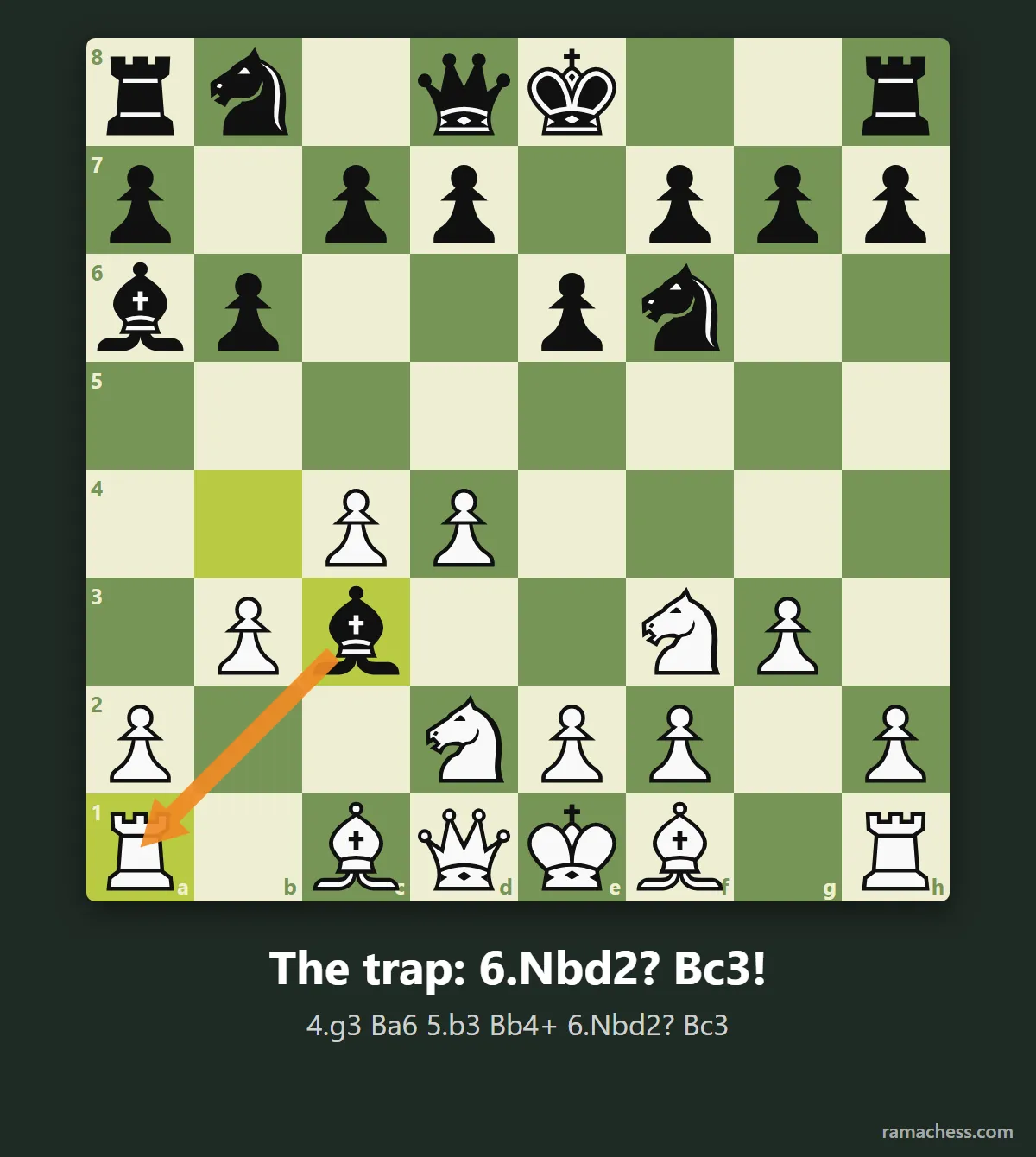
The main line of the fianchetto has a trap that catches many White players. After 1.d4 Nf6 2.c4 e6 3.Nf3 b6 4.g3 Ba6 5.b3 Bb4+ White must block the check. The natural-looking 6.Nbd2? is a mistake because of 6...Bc3!. The bishop attacks the a1 rook. After 7.Rb1 Bb7 Black threatens ...Bxf3 and then ...Bxd4, and White cannot hold the d4 pawn. We checked this with Stockfish: Black comes out a clean pawn up. The right move is 6.Bd2, which is the main line.
Other typical tactics:
- Long-diagonal pins. When the f3 knight moves, the b7 bishop may hit the rook on h1 or a piece on g2.
- Knight on e4. A Black knight on e4 can trade White's best pieces and fix the light squares.
- The d5 push. For White, d4-d5 can cut the b7 bishop out of the game, sometimes as a pawn sacrifice.
Who plays the Queen's Indian?
The Queen's Indian has been a trusted defence at the top for a long time. It is often played by solid positional players who want a safe but rich game with Black. On the White side, Garry Kasparov made the Petrosian Variation 4.a3 famous in his early years, and players such as Veselin Topalov and Magnus Carlsen have played lines with 5.Qc2. You can watch engines handle it in our engine games in the Queen's Indian.
Is it right for you? The Queen's Indian suits players who like calm positions with clear plans. Pair it with the Nimzo-Indian against 3.Nc3, and you have a complete answer to 1.d4 Nf6 2.c4 e6.
Practice the Queen's Indian Defense in the Rama Chess trainer
Reading a guide is the first step. To make the moves stick, practise them. Our opening trainer has 59 Queen's Indian Defense lines. Each one is checked with Stockfish. You watch the moves with arrows, replay them from memory, then take a test. The full set of lines is part of Rama Chess Premium.
Our biggest group is the fianchetto with 4.g3 (E15), the line you will meet most. The trainer also holds a few Bogo-Indian (E11) and Nimzo-Indian (E20 to E25) lines that come from the same move orders.
See all our chess opening guides.
Queen's Indian Defense FAQ
What are the moves of the Queen's Indian Defense?
The Queen's Indian starts with 1.d4 Nf6 2.c4 e6 3.Nf3 b6. Black then plays ...Bb7 or ...Ba6.
Is the Queen's Indian Defense solid?
Yes. It is one of the most solid answers to 1.d4. Black keeps a healthy pawn structure and controls the key e4 square with pieces.
What is the difference between the Queen's Indian and the Nimzo-Indian?
Both start with 1.d4 Nf6 2.c4 e6. If White plays 3.Nc3, Black can play the Nimzo-Indian with 3...Bb4. If White plays 3.Nf3, Black often plays the Queen's Indian with 3...b6.
What is the Petrosian Variation?
It is 1.d4 Nf6 2.c4 e6 3.Nf3 b6 4.a3. White stops ...Bb4 and prepares Nc3 and e4. Garry Kasparov played it often early in his career.
What is the trap with 5...Bb4+ in the Queen's Indian?
After 1.d4 Nf6 2.c4 e6 3.Nf3 b6 4.g3 Ba6 5.b3 Bb4+, the move 6.Nbd2? runs into 6...Bc3! hitting the a1 rook, and Black wins the d4 pawn. White should play 6.Bd2.
Is the Queen's Indian good for beginners?
Yes, for players who like quiet positions. The plans are clear and there are few early traps for Black, but it can lead to slow games, so it suits patient players.
Watch on YouTube
Prefer video? Our channels show real games move by move, with clear explanations.
Ready to practise?
You know the ideas. Now train the moves until you play them without thinking.