Petroff Defense, Scotch Game and Four Knights: Moves, Plans and Traps
After 1.e4 e5 2.Nf3 there is more than the Ruy Lopez and the Italian. This page covers three classical open games: the Petroff Defense (2...Nf6), the Scotch Game (3.d4) and the Four Knights. You get the ideas, the main lines with ECO codes, two real traps and 95 trainer lines.

What are these openings?
All three start with 1.e4 e5 2.Nf3. White attacks the e5 pawn, and Black decides how to answer.
- The Petroff Defense, also called the Russian Game, is 1.e4 e5 2.Nf3 Nf6. Black does not defend e5 but attacks e4 instead. It is named after Alexander Petrov, a 19th-century Russian player. ECO codes C42-C43.
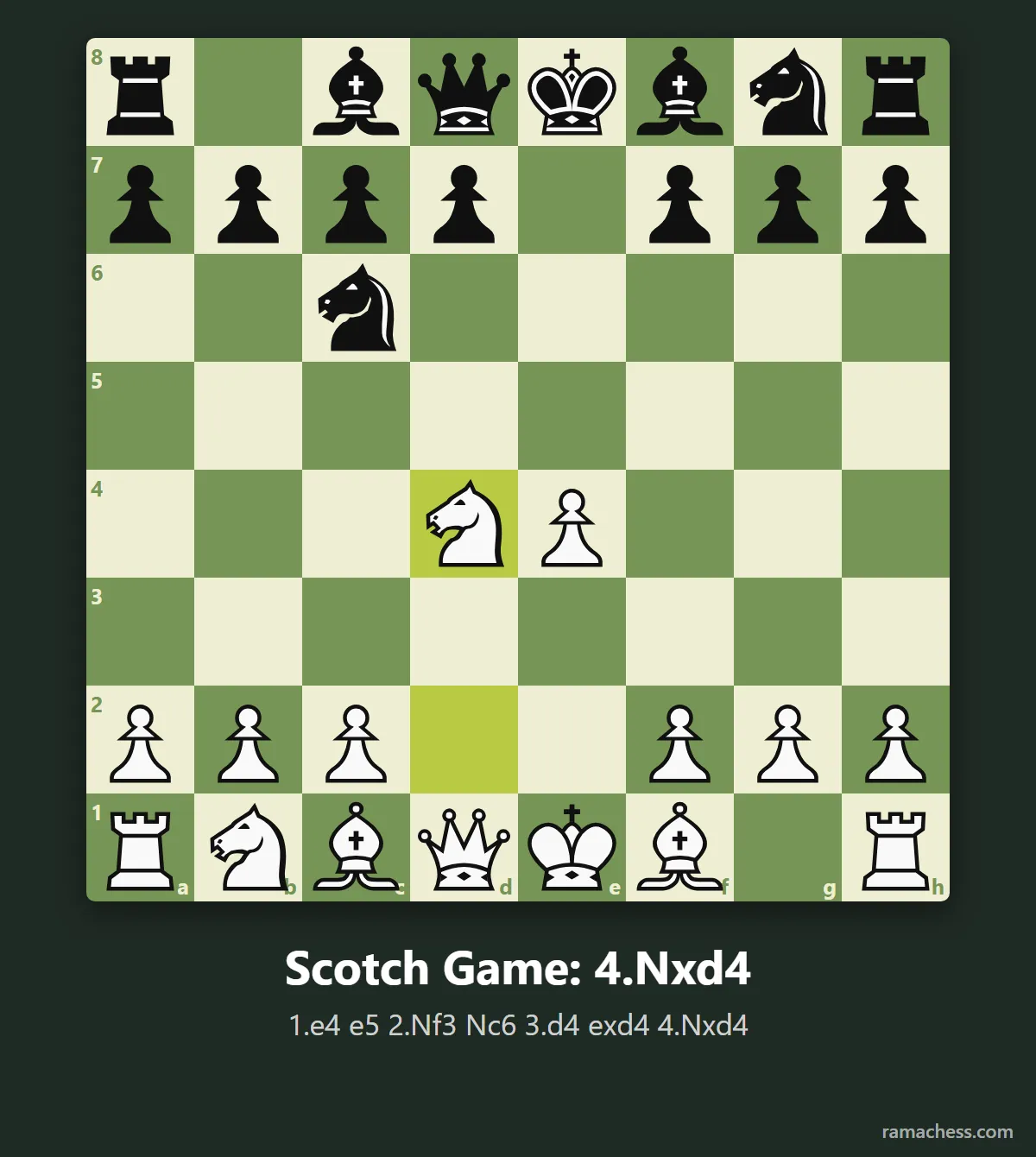
- The Scotch Game is 1.e4 e5 2.Nf3 Nc6 3.d4. White opens the centre at once. The name comes from an 1824 correspondence match between Edinburgh and London. ECO codes C44-C45.
- The Four Knights Game is 1.e4 e5 2.Nf3 Nc6 3.Nc3 Nf6. Both sides bring out their knights first. ECO codes C46-C49.
The trainer folder also holds some lines of the Philidor Defence (1.e4 e5 2.Nf3 d6, ECO C41).
The main ideas for both sides
In the Petroff
Black wants a solid, equal game. After 3.Nxe5 Black must first play 3...d6 to kick the knight, and only then take on e4. The resulting positions are often symmetrical. White tries to use the extra tempo: pressure on the e4 knight with c4 and Re1, or castling long and attacking in the Nimzowitsch Attack with 5.Nc3.
In the Scotch
White gets a free hand in the centre and quick development. The knight on d4 is strong, so Black attacks it with ...Bc5 or ...Qf6, or trades it with ...Nxd4. In the 4...Nf6 lines White often accepts doubled c-pawns for Black in return for space with e5 and c4.
In the Four Knights
Development first, decisions later. With 4.Bb5 the game turns into a calm Spanish-like position; with 4.d4 it becomes a Scotch. A famous Black idea is 4...Nd4 (the Rubinstein Variation), which offers a pawn for active play.
Main variations at a glance
Every move order below is checked move by move.
| Variation | ECO | Moves | Idea |
|---|---|---|---|
| Petroff, Classical | C42 | 1.e4 e5 2.Nf3 Nf6 3.Nxe5 d6 4.Nf3 Nxe4 5.d4 d5 6.Bd3 | the main line; symmetrical and solid |
| Petroff, Nimzowitsch Attack | C42 | 1.e4 e5 2.Nf3 Nf6 3.Nxe5 d6 4.Nf3 Nxe4 5.Nc3 Nxc3 6.dxc3 | White castles long and attacks |
| Petroff, Steinitz 3.d4 | C43 | 1.e4 e5 2.Nf3 Nf6 3.d4 Nxe4 4.Bd3 d5 5.Nxe5 | White opens the centre at once |
| Scotch, Classical | C45 | 1.e4 e5 2.Nf3 Nc6 3.d4 exd4 4.Nxd4 Bc5 | the bishop hits the d4 knight |
| Scotch, Mieses | C45 | 1.e4 e5 2.Nf3 Nc6 3.d4 exd4 4.Nxd4 Nf6 5.Nxc6 bxc6 6.e5 | Kasparov's favourite structure |
| Scotch Gambit | C44 | 1.e4 e5 2.Nf3 Nc6 3.d4 exd4 4.Bc4 | quick development and pressure on f7 |
| Scotch Four Knights | C47 | 1.e4 e5 2.Nf3 Nc6 3.Nc3 Nf6 4.d4 | the Four Knights with an early d4 |
| Spanish Four Knights | C48-C49 | 1.e4 e5 2.Nf3 Nc6 3.Nc3 Nf6 4.Bb5 | a Ruy Lopez with both knights out |
| Philidor Defence | C41 | 1.e4 e5 2.Nf3 d6 | solid; Black supports e5 with a pawn |
The Scotch Game (Scotch Opening) in more detail
After 1.e4 e5 2.Nf3 Nc6 3.d4 exd4 4.Nxd4 Black has two main replies. 4...Bc5 is the Classical: the bishop attacks the d4 knight, and White usually defends with 5.Be3 or 5.Nb3, or trades with 5.Nxc6. 4...Nf6 attacks e4. Then 5.Nxc6 bxc6 6.e5 is the Mieses Variation: White kicks the knight and gains space.
Garry Kasparov led a revival of the Scotch in the late 20th century. He liked it because it gives Black long-term problems and avoids the huge theory of the Ruy Lopez.
Traps and typical tactics
Trap 1: the Petroff copy-cat. After 1.e4 e5 2.Nf3 Nf6 3.Nxe5 the natural copy 3...Nxe4? is already a mistake. White plays 4.Qe2!, and if Black retreats with 4...Nf6?? then 5.Nc6+ is a discovered check that wins the queen. Stockfish rates it as more than five pawns for White. Black's best after 4.Qe2 is 4...Qe7, but White still keeps the better game. The lesson: in the Petroff, play 3...d6 first.
Trap 2: the early bishop. In the Nimzowitsch Attack, after 1.e4 e5 2.Nf3 Nf6 3.Nxe5 d6 4.Nf3 Nxe4 5.Nc3, the move 5...Bf5?? loses a piece to 6.Qe2: the e4 knight is pinned against the e-file and cannot be saved (Stockfish: about +3.6 for White). The normal move is 5...Nxc3.
In the Scotch, watch for the fork ...Qh4 or ...Qf6 against e4 and f2, and for Nxc6 followed by e5 kicking Black's f6 knight.

Who plays these openings?
The Petroff has been used by many world-class defenders, including Vasily Smyslov, Tigran Petrosian, Anatoly Karpov, Vladimir Kramnik and Fabiano Caruana. It is known as one of the most reliable drawing weapons for Black. The Scotch had its modern revival thanks to Garry Kasparov. The Four Knights is popular with club players who like simple, logical development. Engines play all of them; see our engine games in the Petroff and engine games in the Scotch.
Practice the Petroff, Scotch and Four Knights in the Rama Chess trainer
Reading a guide is the first step. To make the moves stick, practise them. Our opening trainer has 95 Petroff, Scotch and Four Knights lines. Each one is checked with Stockfish. You watch the moves with arrows, replay them from memory, then take a test. The full set of lines is part of Rama Chess Premium.
The trainer has a big Petroff section (C42) and many Scotch lines (C45). Choose the side you play: lines are marked White or Black.
See all our chess opening guides.
Petroff, Scotch and Four Knights FAQ
What are the moves of the Petroff Defense?
The Petroff (Petrov) Defense is 1.e4 e5 2.Nf3 Nf6. The main line goes 1.e4 e5 2.Nf3 Nf6 3.Nxe5 d6 4.Nf3 Nxe4 5.d4 d5 6.Bd3.
Why is the Petroff also called the Russian Game?
It is named after the Russian player Alexander Petrov, who popularised it in the 19th century, and it was also studied by other Russian players, so it is often called the Russian Game.
Can Black play 3...Nxe4 in the Petroff?
It is a mistake. After 1.e4 e5 2.Nf3 Nf6 3.Nxe5 Nxe4 4.Qe2 Black is in trouble, and 4...Nf6?? loses the queen to 5.Nc6+. Black should play 3...d6 first.
What are the moves of the Scotch Game?
The Scotch is 1.e4 e5 2.Nf3 Nc6 3.d4 exd4 4.Nxd4. Black usually answers 4...Bc5 or 4...Nf6.
What is the Four Knights Game?
It is 1.e4 e5 2.Nf3 Nc6 3.Nc3 Nf6, where both sides develop their knights first. White then chooses between 4.Bb5 (Spanish Four Knights) and 4.d4 (Scotch Four Knights).
Is the Petroff a drawish opening?
It has a reputation for being solid and leading to many draws at top level, but it is not dull: the Nimzowitsch Attack with 5.Nc3 and opposite-side castling gives sharp games.
Watch on YouTube
Prefer video? Our channels show real games move by move, with clear explanations.
Ready to practise?
You know the ideas. Now train the moves until you play them without thinking.