Italian Game (Giuoco Piano): Moves, Plans, Main Lines and Traps
The Italian Game starts with 1.e4 e5 2.Nf3 Nc6 3.Bc4. The bishop goes to its best diagonal at once and looks at f7, the weakest square in Black's camp. It is one of the first openings every player learns, and today it is also a top-level weapon. This guide covers the plans, the main lines with ECO codes, real traps and 35 lines you can train.

What is the Italian Game?
The Italian Game is 1.e4 e5 2.Nf3 Nc6 3.Bc4. White develops a knight, then the bishop to c4. From there the bishop controls the d5 square and points at f7, which only Black's king defends at the start.
The name comes from Italian players of the 16th and 17th centuries, such as Giulio Cesare Polerio and Gioachino Greco, who studied it. "Giuoco Piano" is Italian for "quiet game". It is the name for the line 3...Bc5, where Black copies White and puts the bishop on c5. The ECO codes are C50 to C54 for 3...Bc5 and C55 to C59 for the Two Knights Defence, 3...Nf6.
The main ideas for both sides
White's plans
- c3 and d4. The classical plan: build a big pawn centre and push Black's pieces back.
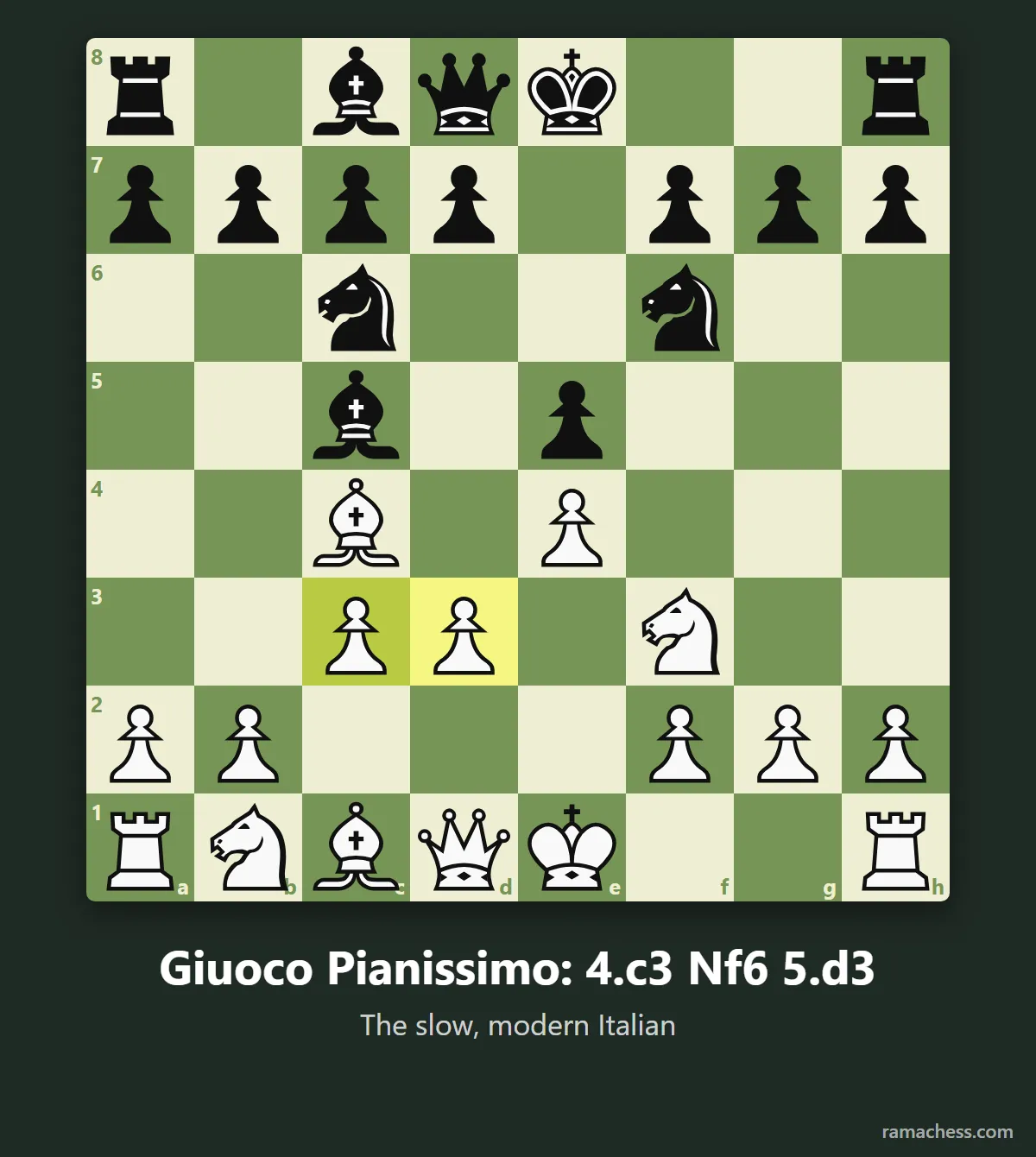
- The slow build-up. In the modern Italian White plays c3 and d3, castles, then Re1, h3, a4 and the knight trip Nbd2-f1-g3. The fight comes later, in the middlegame.
- Pressure on f7. The c4 bishop helps any attack on f7, with Ng5 or a rook on the f-file.
Black's plans
- Develop and castle. ...Bc5, ...Nf6, ...d6 and ...O-O give Black a sound, mirror-like position.
- The ...d5 break. When White plays slowly, Black can strike with ...d5 to free the game.
- Kick the bishop. ...a6 and ...Ba7 save Black's bishop from a4-a5 or d4 ideas; ...Na5 can chase White's bishop.
Main variations of the Italian Game
These are the main lines you will meet. Each move order is checked move by move.
| Variation | ECO | Moves | Idea |
|---|---|---|---|
| Giuoco Piano | C53-C54 | 1.e4 e5 2.Nf3 Nc6 3.Bc4 Bc5 4.c3 | c3 prepares d4 |
| Giuoco Pianissimo | C50 / C54 | 1.e4 e5 2.Nf3 Nc6 3.Bc4 Bc5 4.c3 Nf6 5.d3 | slow build-up; the top-level main line |
| Classical main line | C54 | 1.e4 e5 2.Nf3 Nc6 3.Bc4 Bc5 4.c3 Nf6 5.d4 exd4 6.cxd4 Bb4+ | open centre, quick fights |
| Evans Gambit | C51-C52 | 1.e4 e5 2.Nf3 Nc6 3.Bc4 Bc5 4.b4 | a pawn for fast development and the centre |
| Two Knights Defence | C55-C59 | 1.e4 e5 2.Nf3 Nc6 3.Bc4 Nf6 | Black counter-attacks e4 |
| Two Knights, 4.Ng5 | C57-C59 | 1.e4 e5 2.Nf3 Nc6 3.Bc4 Nf6 4.Ng5 d5 5.exd5 Na5 | the main answer: Black gives a pawn for play |
| Fried Liver Attack | C57 | 1.e4 e5 2.Nf3 Nc6 3.Bc4 Nf6 4.Ng5 d5 5.exd5 Nxd5 6.Nxf7 | knight sacrifice on f7 |
| Hungarian Defence | C50 | 1.e4 e5 2.Nf3 Nc6 3.Bc4 Be7 | very solid, very passive |
The Giuoco Pianissimo ("very quiet game") is the slow plan with d3. It looks harmless, but it keeps a lot of play in the position, which is why it is so popular at the top. White's typical moves: c3, d3, O-O, Re1, h3, a4, Nbd2-f1-g3.
The Evans Gambit (4.b4) is named after the Welsh sea captain William Davies Evans, who played it in the 1820s. White gives the b-pawn to win time for c3 and d4. It was a favourite of the attacking players of the 19th century.
The Two Knights Defence (3...Nf6) is more active. It invites 4.Ng5, attacking f7. Black's best answer is 4...d5 5.exd5 Na5: Black gives a pawn but gets fast development and chases the bishop.
Traps and typical tactics
The Fried Liver Attack. In the Two Knights, after 1.e4 e5 2.Nf3 Nc6 3.Bc4 Nf6 4.Ng5 d5 5.exd5, the natural recapture 5...Nxd5? is a mistake. White can sacrifice the knight with 6.Nxf7! Kxf7 7.Qf3+, and Black's king must come to e6 to keep the d5 knight. Stockfish gives White a clear advantage after 5...Nxd5 (about +0.8). In club games Black's king often does not survive. The safe move for Black is 5...Na5.
Quick tactics to know:
- Bxf7+. When Black's king is still on e8 and f7 is weak, Bxf7+ followed by Ng5 or Qb3 can win material.
- The fork trick ...Nxe4. In some lines Black can take e4 and answer Nxe4 with ...d5, hitting bishop and knight.
- Ng5 too early. Moving the same piece twice can backfire: in the Two Knights Black often wins the c4 bishop with ...Na5 or gets a big lead in development.

Who plays the Italian Game?
The Italian was the main opening of the 19th century and then went out of fashion at top level for a long time. Since the 2010s the slow d3 Italian has come back, and Magnus Carlsen and many other elite players use it often, partly as a way to avoid the Berlin Defence of the Ruy Lopez. Engines like it too; you can watch examples in our engine games in the Giuoco Piano.
Is it right for you? For beginners it is perhaps the best first opening with White: every move follows the basic rules of development. Later you can switch to the Ruy Lopez for even more long-term pressure.
Practice the Italian Game in the Rama Chess trainer
Reading a guide is the first step. To make the moves stick, practise them. Our opening trainer has 35 Italian Game lines. Each one is checked with Stockfish. You watch the moves with arrows, replay them from memory, then take a test. Some lines are free for everyone; the others are part of Rama Chess Premium.
Start with the Giuoco Piano lines (C50, C53, C54), then learn the Two Knights with 5...Na5 (C58-C59) so you are ready if your opponent plays 3...Nf6. Two lines are free.
See all our chess opening guides.
Italian Game FAQ
What are the moves of the Italian Game?
The Italian Game is 1.e4 e5 2.Nf3 Nc6 3.Bc4. If Black answers 3...Bc5 it is the Giuoco Piano; if Black plays 3...Nf6 it is the Two Knights Defence.
What is the difference between the Italian Game and the Giuoco Piano?
The Italian Game is the whole family after 3.Bc4. The Giuoco Piano is the main branch, 3...Bc5, where both sides put their bishops on c4 and c5.
What is the Fried Liver Attack?
It is the knight sacrifice 1.e4 e5 2.Nf3 Nc6 3.Bc4 Nf6 4.Ng5 d5 5.exd5 Nxd5 6.Nxf7. After 6...Kxf7 7.Qf3+ Black's king is forced into the open. Black avoids it with 5...Na5.
Is the Italian Game good for beginners?
Yes. It develops pieces quickly, controls the centre and prepares castling, which are the main rules of the opening. It also teaches you to watch the weak f7 square.
What is the Evans Gambit?
It is 1.e4 e5 2.Nf3 Nc6 3.Bc4 Bc5 4.b4. White gives a pawn to gain time for c3 and d4. It is named after Captain William Davies Evans, who played it in the 1820s.
What is the Giuoco Pianissimo?
It is the slow plan with d3 instead of an early d4, for example 1.e4 e5 2.Nf3 Nc6 3.Bc4 Bc5 4.c3 Nf6 5.d3. It keeps many pieces on the board and is popular with top players today.
Watch on YouTube
Prefer video? Our channels show real games move by move, with clear explanations.
Ready to practise?
You know the ideas. Now train the moves until you play them without thinking.